

|
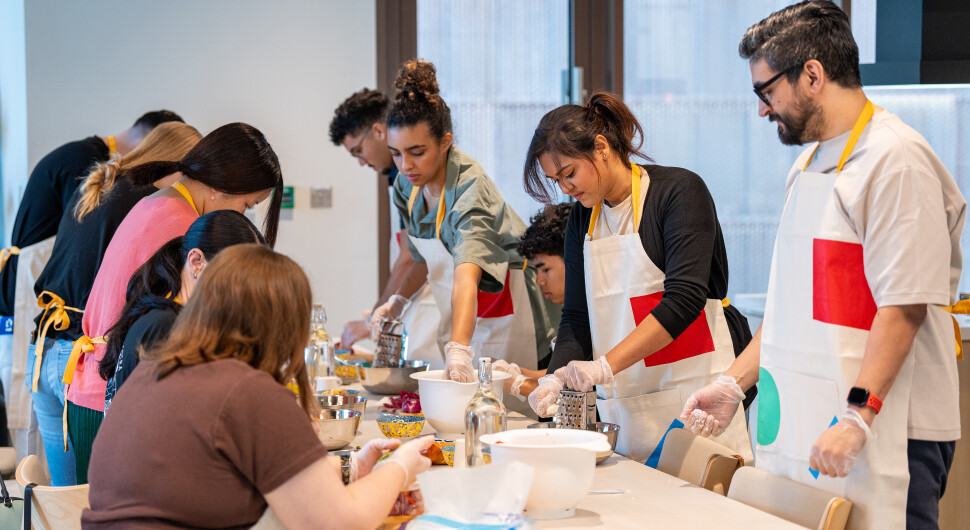
How do everyday conversations shape the ways we share knowledge, build relationships, and understand one another? Led by Dr. Viviana Checchia, this participatory studio seminar explores the role of informal conversations, storytelling, and collective gatherings in shaping social relationships and exchanging knowledge. Through conversation and shared readings, participants will consider how everyday exchanges can create spaces for expressing ideas, sharing experiences, and challenging established social structures. Drawing on feminist perspectives that reconsider forms of communication historically associated with women and often dismissed as trivial or inconsequential, the seminar explores how informal gatherings can become spaces of solidarity, political expression, and collective knowledge-making. Inspired by Dr. Checchia’s memories of women gathering to cook and exchange stories in southern Italy, the seminar considers how domestic spaces and shared activities have enabled women to articulate perspectives and exchange ideas that might otherwise remain unspoken. The session will include a visit to the Mina Zayed fruit and vegetable market to source seasonal ingredients, followed by a collective cooking session centered on a recipe developed by local chef and artist Moza Al Matrooshi. As participants prepare food and gather around the table, conversation will unfold alongside readings and prompts that invite them to reflect on their own experiences of sharing stories and knowledge. Open to everyone, the seminar invites participants to explore how everyday acts of gathering, cooking, and conversation can become spaces for collective thinking, exchange, and connection. Accessibility & Participation Ages: 18+ No prior experience required. Language: English |
About the InstructorsViviana Checchia is a curator, programmer, and researcher active internationally, and currently Director of Metal - Peterborough and Cambridgeshire. She has recently moved from her role as Director of Void Art Centre in Derry, where she and the Void team created a living practice of Social Permaculture. Viviana is also Co-Director of ‘Vessel’, an international curatorial platform based in Puglia, South of Italy, for the support of social, cultural, and economic development through contemporary art.Other posts include Residency Curator at Delfina Foundation, London, Senior Lecturer on the MFA at HDK-Valand, University of Gothenburg and Public Engagement Curator at the Centre for Contemporary Arts, Glasgow. Viviana has produced and contributed to a range of international projects, including the Young Artist of the Year Award, Ramallah and the 4th Athens Biennale. Viviana has lectured on curatorial studies and contemporary art practice at amongst others: British School in Rome; the Centre for Curatorial Studies, Bard College, New York; the ‘Social Practice and the Creative Environment’ Masters programme at Limerick Institute of Technology; the International Academy of Art Palestine, Ramallah. With Anna Santomauro, she received the 2013 ICI/Dedalus Research Award for research into the legacy of socially-engaged art practice in the U.S., and in 2016 was awarded the Igor Zabel Award for Culture and Theory Laureate’s choice for her contributions to the comprehension of and international interest in Eastern European art. Viviana holds a PhD from Loughborough University that focused on alternative Mediterranean curatorial practices. She currently serves as a trustee of cultural organisation, Timespan, Helmsdale, Scotland. Moza Almatrooshi is an artist and chef based in the UAE. Her practice operates at the intersection of food, agriculture, and site-responsive research, using eating as both method and medium. She holds an MFA in Fine Arts from the Slade School of Fine Art, UCL (London), and a Diploma in Patisserie from ICCA (Dubai). Working across installation, public programmes, and culinary formats, Almatrooshi approaches food as a material through which ecological, social, and historical relations are activated. Her work often emerges through sustained engagement with landscapes, including practices of foraging, sourcing, and working alongside local forms of knowledge. Through her landscape-to-table culinary studio ballad, she develops projects that translate artistic research into shared, edible encounters. These projects foreground the entanglements between land, labour, and nourishment, positioning the table as a site of collective attention, transmission, and care. |