
Figure and Ground is a series conceived by Nadine Khalil for Warehouse421 that synthesizes particular threads of artistic practice from the point of view of co-creation, polyphony, and community. Here, artist Hashel Al Lamki and Munira Al Sayegh become collaborators in a call-and-response that is emblematic of the cultural infrastructure and modus operandi of the artists, curators, writers, and producers in and around Warehouse421.
The Object of the Story
In considering the assemblages that define Hashel Al Lamki’s artistic practice, Nadine Khalil engages with a kind of disassembly. By taking apart the elements that form the whole, discrete voices rise to the surface, echoing an artist’s journey through objects, and in resonance with the totalizing vision behind The Cup and the Saucer.
There’s something beguiling about Hashel Al Lamki’s sculptures. Whether anthropomorphic totems or life-size creatures, they cannot quite be pinned down. Embracing a handmade, provisional quality and often with added functionality – embedded in massage machines, moving fans and seductive lights – they’re carefully considered and playfully put together. Though made up of ‘stuff’ from the everyday, their articulation lends an almost mythological feel – Hashel seems to be saying that the marginal is like magic. Humble, disregarded materials are reinvented in Art Brut-meets-Bruce High Quality Foundation, and irony isn’t lost.
“I was always a bit rebellious and inappropriate as a kid,” he confesses. But it’s less a lack of propriety and more a curiosity that he exhibits towards material-in-its-environment. This includes paintings of massage cards found in the street (using their actual signage: If you take 4 time service then 1 Service free, African Arabs Indian Thailand Chinese, WellCare and New Seven Star), which comment on the service industry. Hashel’s practice is very much about the non-binary concepts demonstrated in The Cup and the Saucer because he sees the individual and the social as intertwined – co-creators of meaning.
Although for the most part, the sculptures are non-kinetic, you get the feeling they are going to get up and walk. They build a character. Munira sees it as a kind of flamboyance. “It’s as if one element pulls and the other pushes. Unlike his paintings, which reach completion, his sculptures are endless. They live and change. They are alive and they tell him what they need. Only when they are done is he willing to let them go, like releasing children into the world.”
I ask Hashel if he ever knows what his sculpture-creatures are going to become. He answers that he never follows a plan, but it’s more of a flow that incorporates whatever found objects are at hand as tools and structures. “The sculptures especially are very intuitive in terms of what is around me at that moment and how I respond. They reference an ergonomic way of existing,” he says in relation to an awareness of his own footprint and how that translates into repurposing surplus.
Although he cannot delineate a method, he explains how the foundations for this practice developed. “When I was in New York studying art at Parsons [2007-2011], I had access to all possible mediums for the first time. After I graduated, I remained in the city for a few years doing a bunch of odd jobs like video production, photography and even working with a holiday company that installed Christmas lights in places like Macy’s. Today I see that time as a means of gaining exposure to the skills I needed to make these sculptures… For example, I had a phase when I was obsessed with using lights, which were cheap and could be found in any drugstore, and I created a whole series of these light works.”
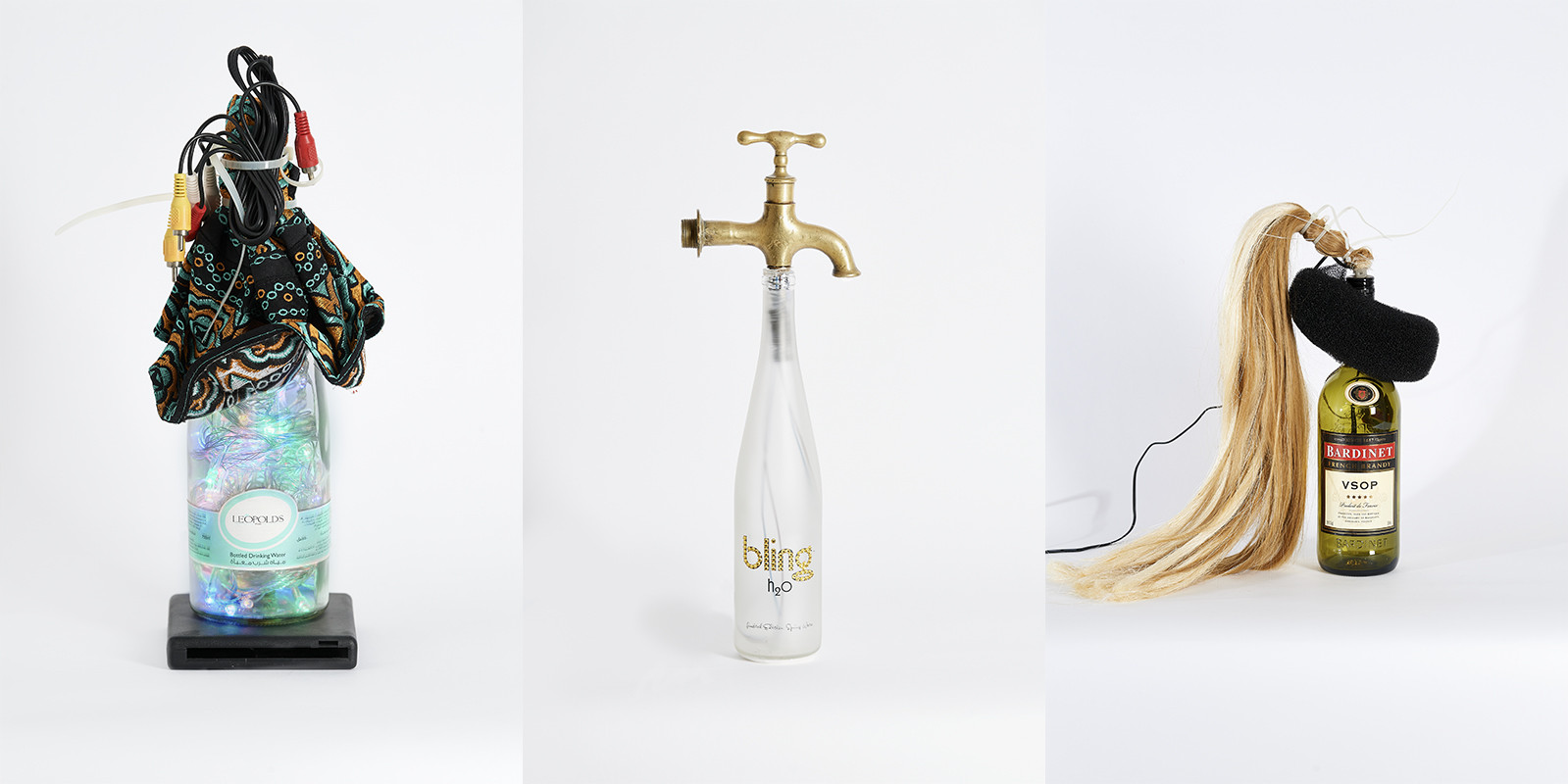
“It’s just about finding constant connections that make up our lives,” he continues. Like dusters for styling hair, lights as substance, HDMI cables as matter, cricket balls for balancing acts and popcorn for towers. He’s in his element at offbeat shops or around disregarded items. “Just leave me in a 99-cent store and I daydream,” he quips. This pull between the ornate and the mundane can be found in the Control and Guilt section of the show, where it’s telling that perhaps the simplest work (in terms of composition) is a H2O bottle, capped by a gold faucet and emblazoned with the tag ‘bling’.
Most of the sculptural works in Warehouse421 elude immediate understanding of the mechanisms at play, integrating a repertoire of hammers, water filters, water balloons, pompoms, fake eyelashes, faux fur, fish weights, bicycle locks, stress balls, hair clips, safety pins, key chains, sanding discs, charcoal supplements and more. And that’s their beauty – the accumulation of things, as accessories or potential instruments, which cannot be entirely unmasked. If you know, you know.
Milk and Honey *
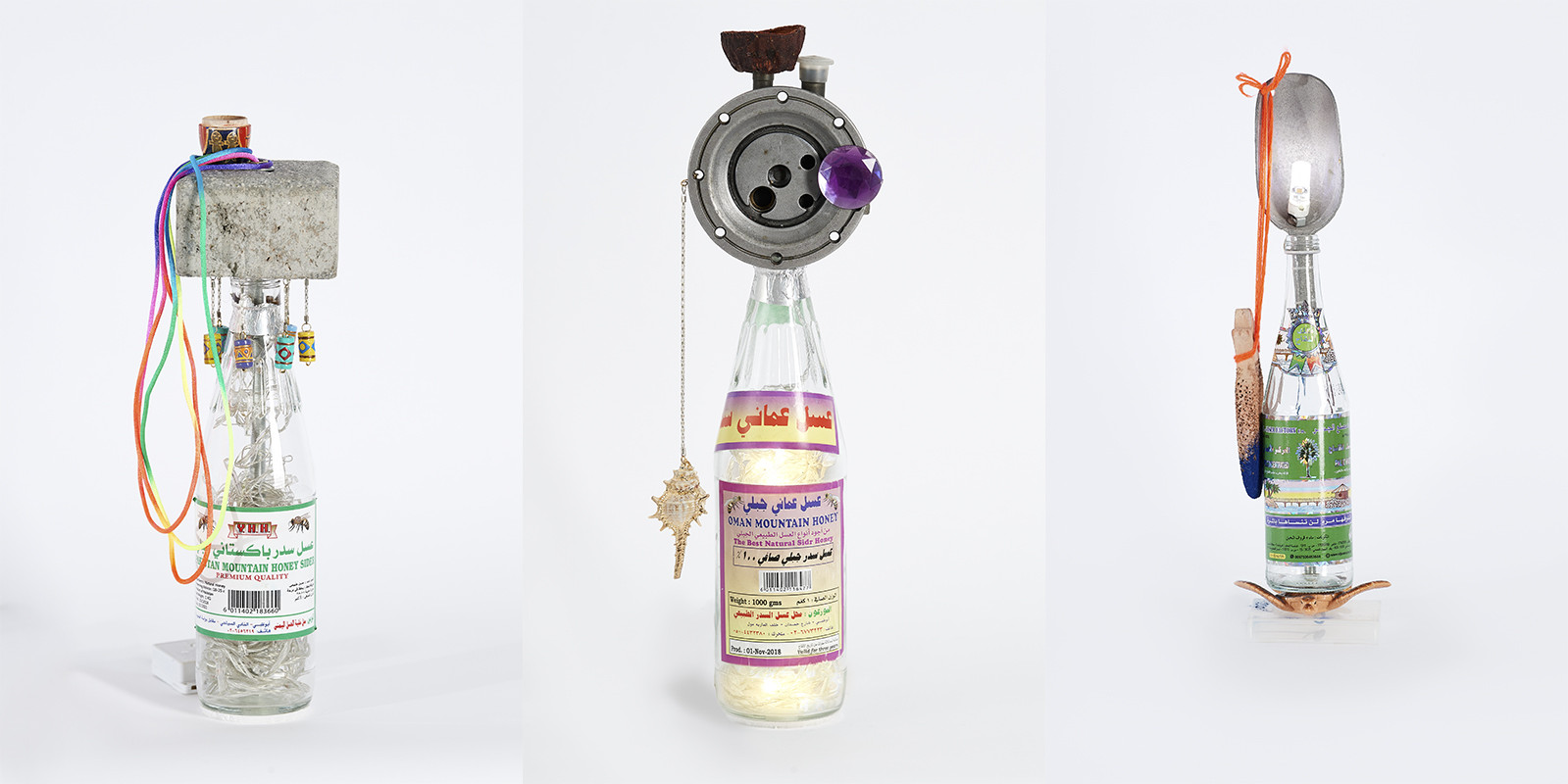
“The honey bottles are a mix of things from Spain and Abu Dhabi. I asked my family to help me collect honey bottles from the region, like from Pakistan and Oman. And these include elements from the flea market in Barcelona that Munira and I visited, where I went wild. I began gathering all kinds of random things, including hardware, which needed to be drilled, and glue to construct into their final form.”
Faceless Traditions
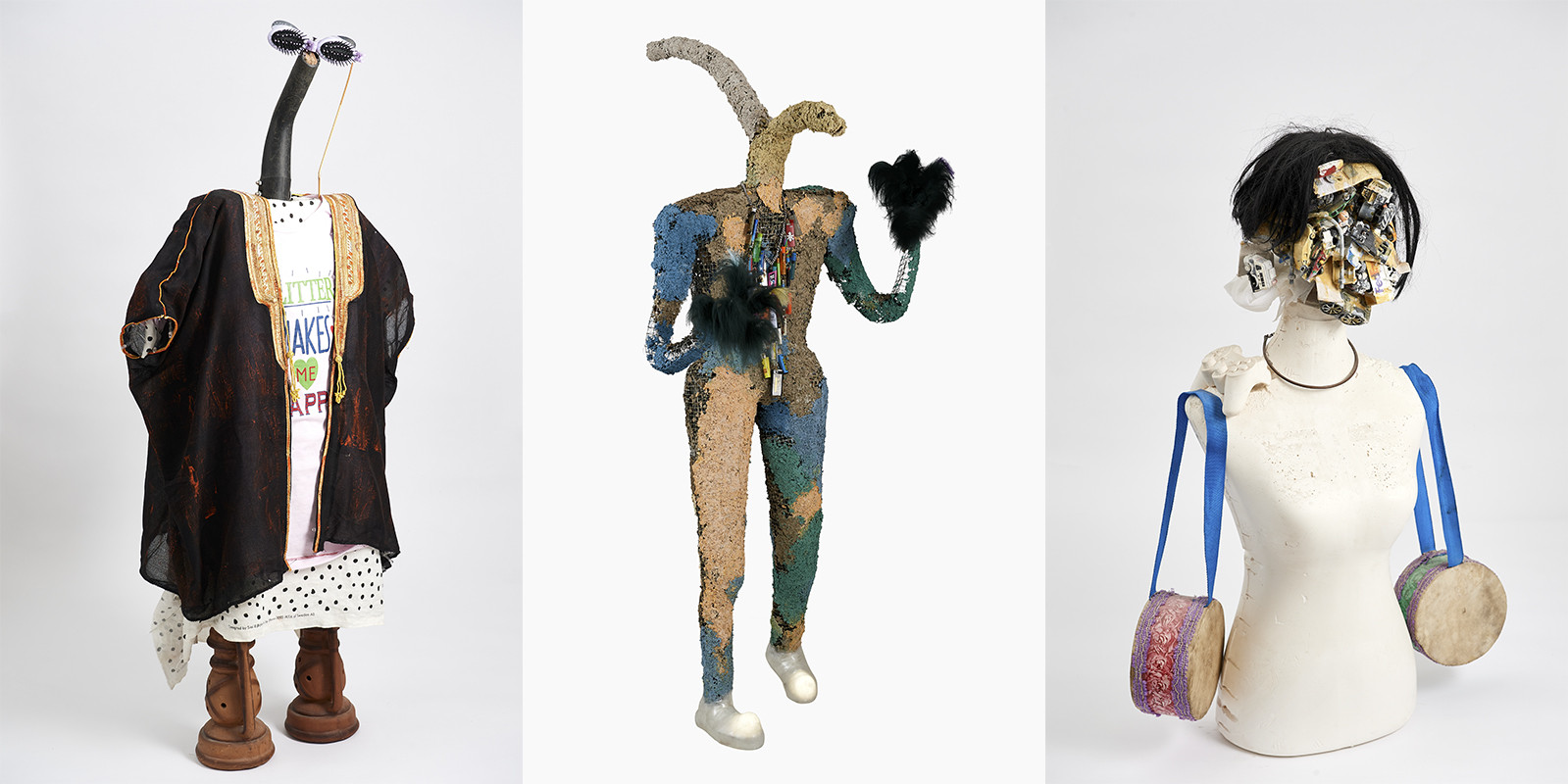
“Sometimes I use traditional elements, like the bisht or the drums used by el Mesaharaty [to rouse people for suhoor during Ramadan]. I live above a KM Hypermarket and so whenever I have a creative block, I go down there. It’s where I got the vacuum pump (neck), the combs (eyes) and the cables from. Big Man wears a necklace of lighters and his body is made from the flower arrangements I took from an iftar meal at Warehouse421 – which would have eventually been thrown away, so they have been returned to the same place! I crushed, dyed and then covered them with a mesh that holds the structure. The feet are light bulbs wrapped in Saran [cling film].”
In a Sequence
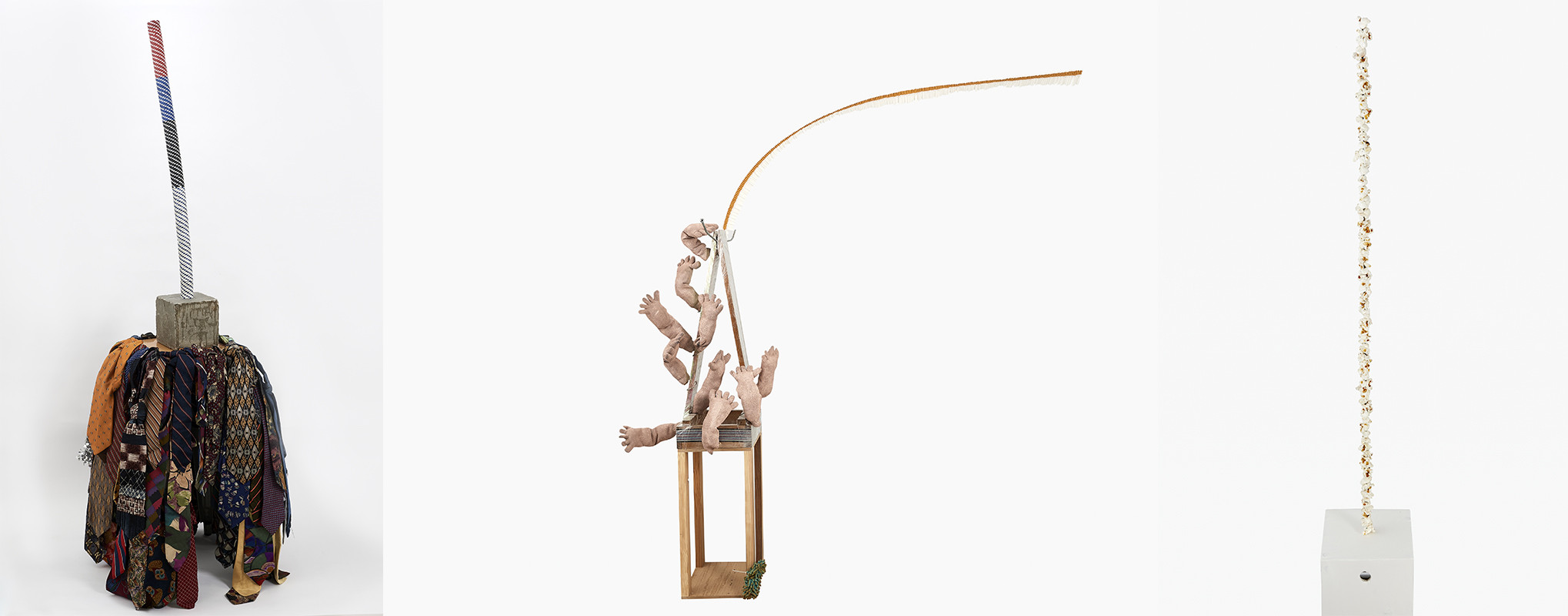
“My first tower was of 8,400 star stickers – it was about validation and self-acceptance. I showed this as part of the SEAF final exhibition in 2016 when I was thinking of these marks of achievement instituted by schools. I had found them during our New York trip during the programme. They were next to the cashier and I remember I grabbed every sheet they had. Then I arranged them by colour.” Stacks of poker chips, liquorice, batteries, pistachios, cigarette, toy cars and Salvation Army buttons followed.
Anatomical Beings
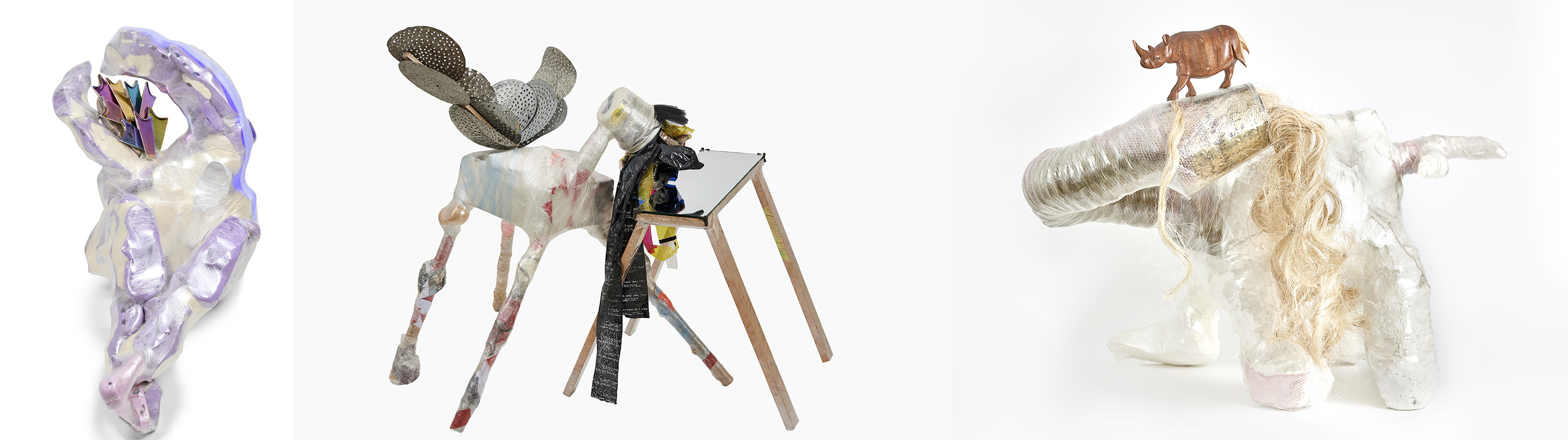
“One day I was buying art supplies with a friend at Dragon Mart, and as we were leaving, I saw a shop that had piles of crocs for just 80 AED, so I took two boxes of them to my studio. The majority of The Yogi sculpture comprises these crocs but the ‘face’ is an incense-burner. The crocs don’t seem to make sense without being worn, and the burner doesn’t make sense unused. So there’s this whole idea of perfecting a hybrid object, where the components might not be logical by themselves. I wrapped them all together until the form emerged.”
Destroy to Create
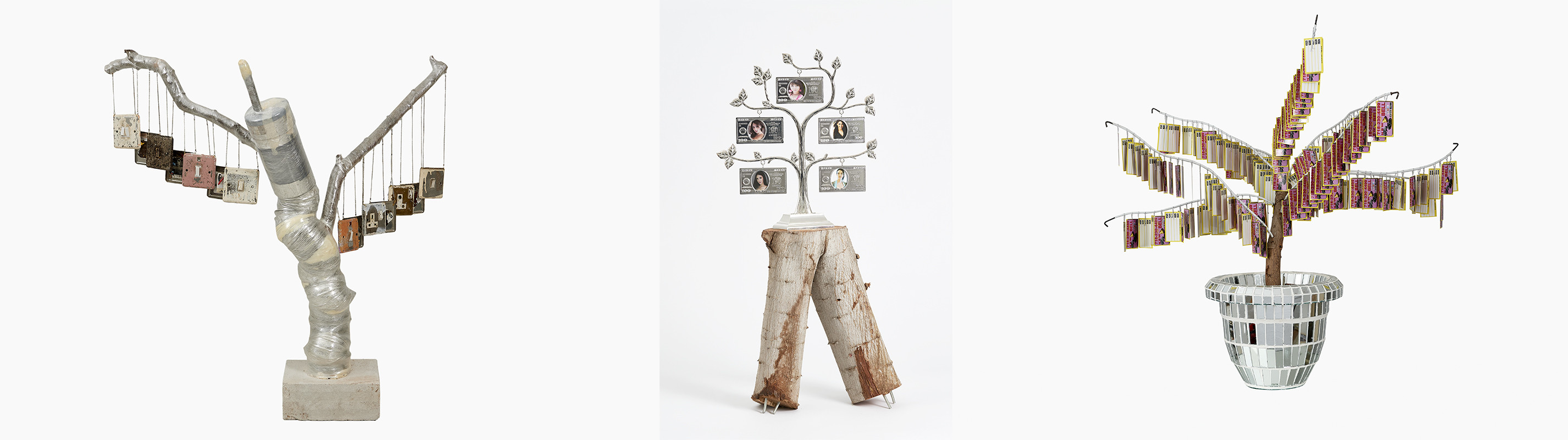
“I live in a neighbourhood in downtown Abu Dhabi that’s constantly changing. The 1980s buildings by Sudanese and Egyptian architects are disappearing in a constant cycle of demolition and rebuilding. When I saw scaffolding infront of one they were going to tear it down, I went inside, fascinated by the idea of accessing a space before it’s destroyed. I noticed how in every apartment, people would customize their light switches and paint over them. I have a box of these – all from the same building. I’m addressing socioeconomic issues through this tree that grows and dies.” He then noted that the ‘trunk’, which sprouts real branches, is made of AC ducts and put together by construction foam. The piece is entitled Hertz tree, named after the building in which its parts were collected.
Every Action has an Equal and Opposite Reaction
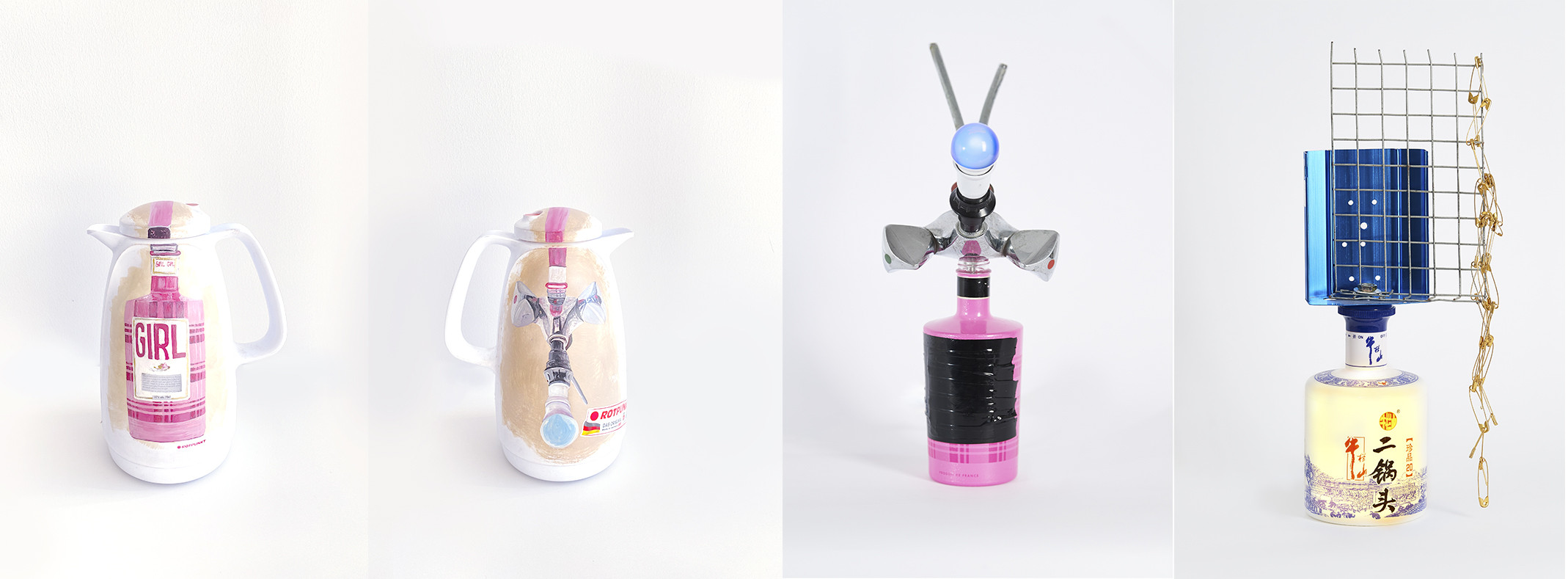
“This bottle with the water faucet had ‘Girl’ on its label. It was one of my early pieces but got censored at a show. We couldn’t remove the masking tape so I decided to remake it for another context. I re-introduced the text by painting the original image on a teapot sculpture. Interestingly, only the English labels on alcohol bottles were marked in that exhibition, not the [less legible] ones in Chinese or Japanese from vintage bottles I bought on ebay. My role as an artist is to have a voice but if it’s offensive to anyone, I try and dilute it.”
So rather than being a performance of failure, this act of remaking conveys that everything can be – and is – art. Art is thus democratized even within societal restrictions. As Munira explains, the idea behind the bottle sculptures is to elevate the conversation around halal and haram as dualities of separation and togetherness, through the lens of guilt and control. “We are no longer looking at bottles here, we are looking at lamps. We tried to desensitize the narrative of overconsumption by including a whole new series of halal bottles, such as the Vimto bottles or rose water,” she says. “The question is how do you constantly respond to such situations without affecting the intention behind the work?”
* All quotes are by Hashel Al Lamki unless otherwise specified