
Reflections on Place, Pace, and Memory
By Finn Murray-Jones
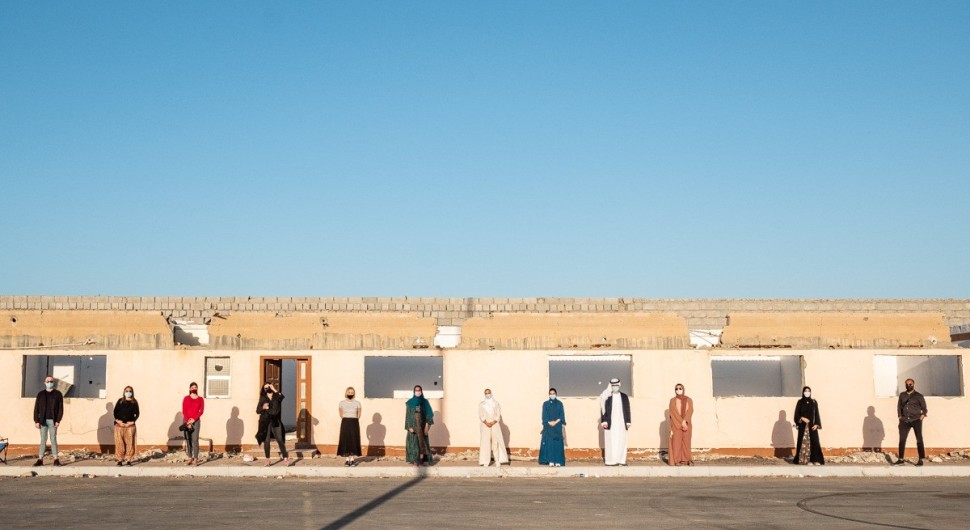
One can find Abu Dhabi’s modern heart in Mina Zayed. Through the rigid grid plan and functional architecture of its municipal buildings, Mina Zayed is emblematic of the pioneering modern spirit that guided Abu Dhabi’s early urban development. From the Automatic Slaughterhouse (which joins a host of automatic bakeries and restaurants around the city) to the multi-storey co-op, from the drive-through markets to the towering cranes that continually loaded and unloaded cargo from across the world, Mina Zayed’s construction in the early 1970s thrust Abu Dhabi into the age of the machine, and into a new world where the lives of its residents were made infinitely more rich through technology. The port’s construction came at the behest of the late ruler of the emirate and the country, Sheikh Zayed bin Sultan Al Nahyan, who was determined to bring Abu Dhabi into the 20th century, and to furnish the city with infrastructure befitting its status as capital of the newly-formed federation.
Ever since, the port has been integral to the city’s development; a locus of change in a continually renewing urban landscape. In many ways, the area represents a microcosm of the rest of the city, and we can trace Abu Dhabi’s burgeoning urban form through the history of the port itself. It is because of this significance to wider history that we selected Mina Zayed as a jumping off point for our first group of mentees. As part of our programme of workshops, seminars, and critique sessions, our participants have responded to the area through the mediums of photography, video, graphic design, digital illustration and multimedia installation, revealing the people, places and structures that make Mina Zayed what it is today.
2020 has turned out to be a particularly historic year for all of us. For Mina Zayed, this year saw the eventual demolition of the Mina Plaza towers, a group of unfinished buildings at the entrance to the port area that have stood dormant for the best part of a decade. While demolition is certainly not an unusual activity in the UAE, this particular demolition was significant, as it marks the beginning of a new phase in Mina Zayed’s history, and a look ahead to a reimagined future for the area. Ever since the transfer of port operations to Al Taweelah in 2012, Mina Zayed itself has been in a sort of limbo, a suspended existence between a flourishing past and an undefined future. As such, the projects you see here have an archival function, documenting and memorialising the Mina as it stands in 2020, on the edge of major transformation.
Sandra’s project explores this state of temporariness, capturing the nostalgic melancholy of a once-thriving industrial area that now lies empty. Throughout her images a repeated motif is found; a visual interruption that protrudes against a carefully composed background, whether that’s a lone orange ball lying in a patch of long, dull grass, or a twisting steel rebar that cuts across a dusty warehouse facade. By capturing the traces of human intervention on a landscape now largely devoid of people, Sandra speaks to this yearning, seemingly at once to the past and to the future. It is this temporal suspension that Lateefa also explores in her work. She presents a series of vignettes: short, looping pieces of film that masquerade as still images. Her work fixes the viewer in this state of perennial temporariness, until small movements in the scene alert the viewer to the fact these are, in actuality, moving images. Both projects explore this tension between past and future, a metaphor for the Mina area as a whole as it teeters on the brink of great change.
Lara also looks ahead to the future in her project, where she proposes a way to repurpose the abandoned dhows lying close to Warehouse421. By sinking the dhows into the sea around the port, they take on a new life as artificial coral reefs, providing a home for marine life. Questioning what we do with our waste is also explored by Aisha, who brings our attention to the detritus that still lines some of the warehouses, leftovers of once flourishing business activity. Both projects raise important questions about conservation and consumption.
Shortly after we began the programme in early 2020, new restrictions on movement were imposed in the UAE as part of efforts to slow the spread of COVID-19. For our mentees, not only was getting to Mina Zayed now more difficult, but simply meeting and interacting with others in the area became more challenging. Mazna’s project documents groups of men that organise informal cricket games on Fridays in the area next to the dhow graveyard. After initially struggling to connect with her subjects, who were at first fearful that she was a government representative checking up on their social-distancing and mask-wearing, she persisted, and eventually won the trust of captain Talha and his team. Her images capture their candour as they share their Friday ritual with her.
Cath is no longer a stranger to the salesmen at the port’s markets. After many days spent hanging out with the vendors, drawing them, chewing the fat over cups of tea, and even joining in the odd game of football, she also pushed through barriers to connect with her subjects. Cath’s constructed museum - the MOOT (Museum of Ordinary Things) - is many things. It’s a documentation of Mina Zayed in 2020, but it’s also a personal record of her time spent exploring, analysing, and mapping her surroundings, of coming to terms with and understanding the area, and in many ways is a statement on the subjective role curators can play in the construction of museums and their collections. Augustine also spent time getting to know another group of semi-transient Mina residents: the drivers that supply the markets with fresh produce from across the UAE and wider region. His immersive installation tells their stories through a careful composition of fragments. His gaze is subtle and nuanced; close, intimate and yet distant, displaying a seriousness of intention - all evidence of his aim to treat his subjects with appropriate dignity.
The warehouses that line Mina Zayed’s gridded streets were once home to a myriad of businesses, performing a whole host of functions. Since the gradual displacement of the warehouse tenants over the past few years, many of these warehouses now lie empty, stripped of any distinguishing signs of former life on the inside. For others, traces of past lives remain, and for some of our participants, it was these remnants that inspired their projects. Mansour struck gold fairly early on in the project, uncovering a treasure trove of diaries, newspaper clippings, and dusty VHS cassettes. Piecing together his findings and inspired by the contents of the newspaper articles he collected, Mansour crafts a pseudo-fictional world of an alien researcher working in Mina Zayed, creating a video of the researcher piecing together evidence in the same way Mansour did his findings from the warehouse. Maryam’s own discovery came in the form of a warehouse full of used wedding decorations adjacent to the wedding hall near the coop. Inspired by her own experiences at weddings of family and friends, Maryam uses her found objects to construct a series of table settings that each critique a particular aspect of wedding culture in the Emirates.
Fatema also draws on her personal experiences through her work, recalling her memories visiting Mina Zayed as a child. Enlisting her own family as models, each scene she constructs tells a story from her childhood, set against the backdrop of Mina Zayed - an anthology of stories where Mina Zayed is the stage. Positioning herself in every scene, we are reminded of the importance of the Mina area for people that grew up in Abu Dhabi. Lena’s project also views Mina Zayed through a very personal lens. The sending of a postcard, no matter how mass-produced and standardised the object itself may be, is a deeply personal gesture. Lena’s choices of imagery for her designs, presented through her signature collage style, represent her own explorations of Mina Zayed, what caught her eye, and what she found interesting enough to share with family and friends further afield.
As we roll into 2021, the first phase of Mina Zayed’s inevitable transformation has already begun. Through documenting Mina Zayed as it existed in 2020, these projects celebrate the area in all of its idiosyncratic glory, and mark the closing of this chapter for Abu Dhabi’s port. Just like Abu Dhabi as a whole, Mina Zayed exists in a state of perpetual change, and in a city with an ever-renewing population and limited collective memory, it’s all the more important to continually document these histories before they disappear completely. I hope these projects can be seen as a call to action to preserve the city’s modern heritage, and to ensure that redevelopment plans for Mina Zayed don’t erase its intrinsic character.