The Delhi Polyphones: The Paraphonic and Polyphonic Hums and Stays of The City
BaRiya
Premise
Are there sounds of our city we desensitize?
Hammers we hear, trains, planes traffic and industries,
surviving lakes with breathless fountains, birds on trees forced to
stand in a line, addresses and approvals – we hear.
Are we missing to hear an integrity, a plead, of the city?
Where do voices of the city find unhindered composition or a state of non-composement
encompassing all its dwellers’ little imaginations and shenanigans?
Do we hear the sound within the sound of the city?
And what of those sounds our dried-out speeches must compress?
Where must the prayers hide in the sound of the city so that clouds and water could reach them?
An undertone of the city? An overtone? A polyphone? Millions of them in a cosmic float?
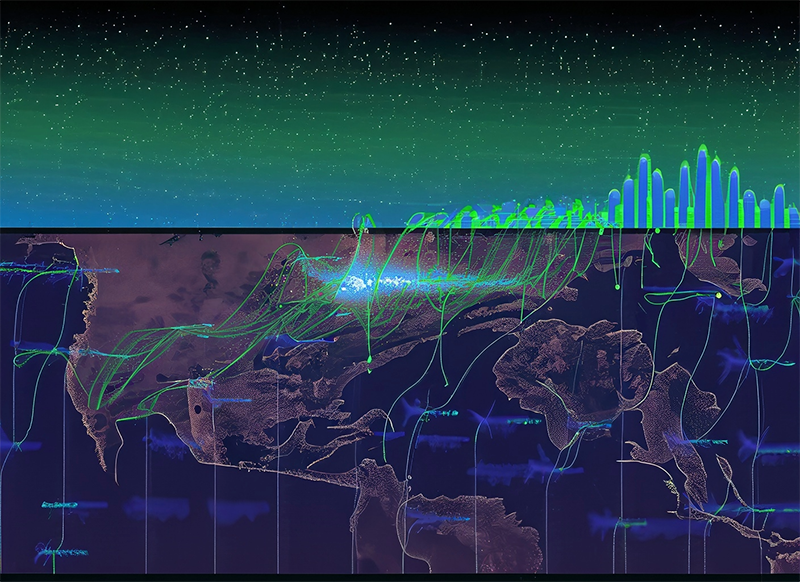
The sound of the city is one of our most decentralized systems. Disintegrated harmonies meet and not at long-wave polyphonic curves. It enjoys autonomy and independence where mergers of new kinds are constantly occurring. Aural auroras of every city. An atmosphere created by the many vocal spheres of the city’s inhabitants, human and non-human. The birds nesting in hundreds of tombs around the city, the train signals, the few surviving lakes, all pulsating electricity with characters of their own. They blend seamlessly into our local sono-spheres. And through BaRiya’s practice of observing overtones and polyphones of regular frictions in and around us, the artists felt that there is an aural, auroral map missing from our sonic palates.
Can we return to the city as a natural body and hear its many paraphonic polyphonic voices which inter-dependably make up our sonic environments? What BaRiya wanted to uncover more closely is which tones make up the city’s sound map. By synthesizing soundscapes through digitally emulating processes of polyphonic overtone singing, Tuvan throat chanting, or Bulgarian polyphonic chanting, the artists were seeking to let the city take the performer’s spot. Rather than looking at a performer’s sound ornating spaces, they wanted to hear what the space is saying in all its multiplicity; to reveal a new imagination of the city. New aural concerns and care. Aural auroras of everydayness, spaces and communities creating a oneness in multitudes, sharing in a timesthesia ritual. A ‘natural entity’ characterized by dystopian noise as much as pristine environments are perceptually characterized by the color green, all parts of an evolving biosphere. All revealed by capturing the sonospheres of the city and presenting them in textual-sonic collages, including ultrasonic and hydrosonic environments. These collages are to be made using not only the sounds as they are, but also synthesizing them to let their overtones and undertones resurface.
What the project is aiming to offer the city is a new hearing. A kind of hearing where a listener's attention and imagination co-create the piece. Thus, the project would include multi-channel compositions playing dissected overtones, undertones, drones from the larger polyphone of the city from Tombs, Lakes, Bridges, Highways, Parks, and Industrial Complexes.
Process
Delhi Polyphone is a series of multichannel compositions and performance, composed solely of Delhi’s undertones, overtones, and many other polyphones. After recording sound-scapes from around Delhi, including tombs, railway stations and tracks, lakes, atmospheric virtual tones, parks, industrial areas, bridges, underpasses, universities, and ultrasonic environments – BaRiya synthesized the captured soundscapes. Using a wide variety of inverse notch filters, the artists picked out strands of tones which go by unheard. Strands that form the multidimensional structure of a polyphonic environment that can be decomposed into an infinite number of harmonics.
These strands give us hints into the metaphysics and a larger resonance of the city – a resonance in which they converge in the form of virtual tones – tones made by the interaction of all the elements of Delhi in a decentralized sonic atmosphere. Aural auroras of an everyday city.
FREQUENCY FILTERING
To bring out the upper and more atmospheric harmonies of the soundscape usually suppressed due to the loudness of fundamental tones, the artists made use of inverse digital notch filter devices, with very sharp resonances. Usually in audio processing, notch filters are used to remove a single frequency or a narrow band of frequencies. Here they aimed at the opposite by heightening narrow bands – overtones, undertones, and polyphonic remains of the city via inverse notch filters with high Q (quality factor) usually up to10. A Q of 1 is equivalent to a bandwidth of 1.38 octaves, while a Q of 6 is equivalent to 0.25 octaves. Through isolating tones they worked with overtones from 1 kHz to 20 kHz, and undertones ranging from 60 hz to 20 hz.
METAPHYSICS OF PROCESS
Identifying new poetical junctions through the polyphonic listening of the city and
spotting/discovering new listening/resting rooms through the virual-real city-terrain.
Witnessing and reconciling sonic traumas.
Exploring through City-Sonic Feuds and finding immediate resolve in the mostly unmeditated
upon spectrums (in the undertone, overtone and polyphones). Familiarizing with each other's
cultural and proverbial listening
imagining and speculating often non-human bioacoustic ways of residing and reconciling with
places of sonic discomfort, looking for respite to the subtlest of unrests.
Polyphones, certain emerging overtones, rumbles of undertones, and mud - all that is considered
unacceptable during mix and master in a studio, when democratized create their own and more truthful vibrant aural auroras.
The melodies discovered here helped us decentralize listening and
bring out the everyday's ephemeral by extending the intimacies of ear-ly hearing outside our bodies and onto the city and sounds on their own.
There exists an ever-renewing reconciliation between the thinnest in the background and the loudest most attentive sparks and fundamentals.
A thinner ecological-listening which comes brings forth a multiplicity/polyphony (hidden underneath evolutionary predator-prey fear-induced evolutionary listening muscle memories).
We are understanding cruelties through the sound spectrum and how deep listening truthfully could go and what all it takes to become sonically inclusive.
Outcomes
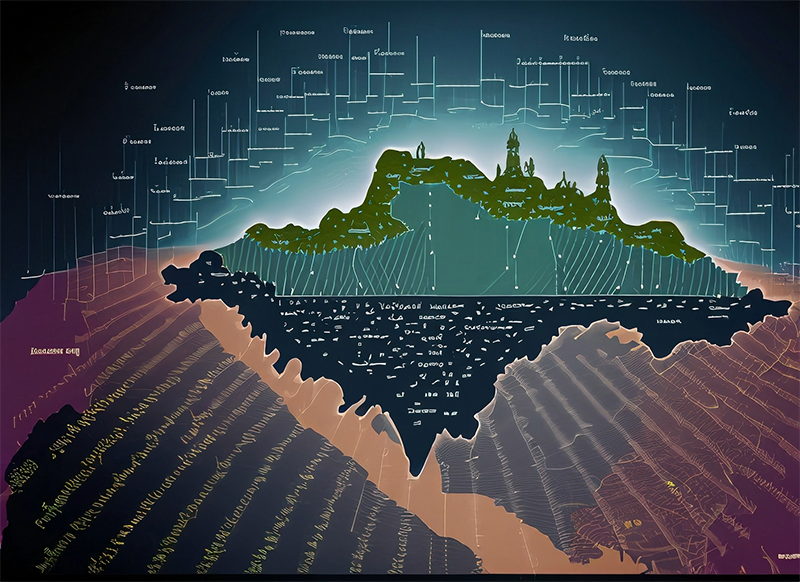
Collecting and synthesizing undertones, overtones and polyphones culminated in a macroscale polyphonic loop of the city’s soundscape, covering more than a hundred kilometers of sonic walks in and around the city, picking through its different sonic textures, andexposing the listener to the City’s feebler and more cosmic dialogues and songs. The loop can be played at multiple listening stations and use tens of polyphonic sounds and text prompts, complemented by graphics depicting the city as a unanimous performer releasing strands of polyphones to the spaces in and around itself. The listener’s imagination completes about half the sounds, from the reception of anger and other emotions through taking part in the shenanigans to finding a magical and spiritual place, reconciling the sonic trauma of the city’s noise. Dystopian noise blends and brews with spiritual harmony to liberate the ear from the knowledge and judgment of the mind, and allow for a new sense of care for the everyday.