
Tala Worrell (b. 1991, New York) is a Lebanese– American painter who grew up in Abu Dhabi. Living and working between Abu Dhabi, Beirut, and New York, Worrell’s paintings hone in on the texture of strange intimate moments that make up the perceptual experience of being both an insider and outsider. Worrell earned her BA in Visual Arts from Brown University in 2014. In 2015 she was a fellow at Ashkal Alwan’s Homework Space Program in Beirut, Lebanon. In 2016, Worrell was a fellow of the Salama bint Ham dan Foundation Emerging Artists Fellowship (SEAF) in Abu Dhabi, UAE. Her works have been shown in several group exhibitions in London, Beirut, New York and Abu Dhabi. Worrell is currently pursuing her MFA in painting at the Rhode Island School of Design.
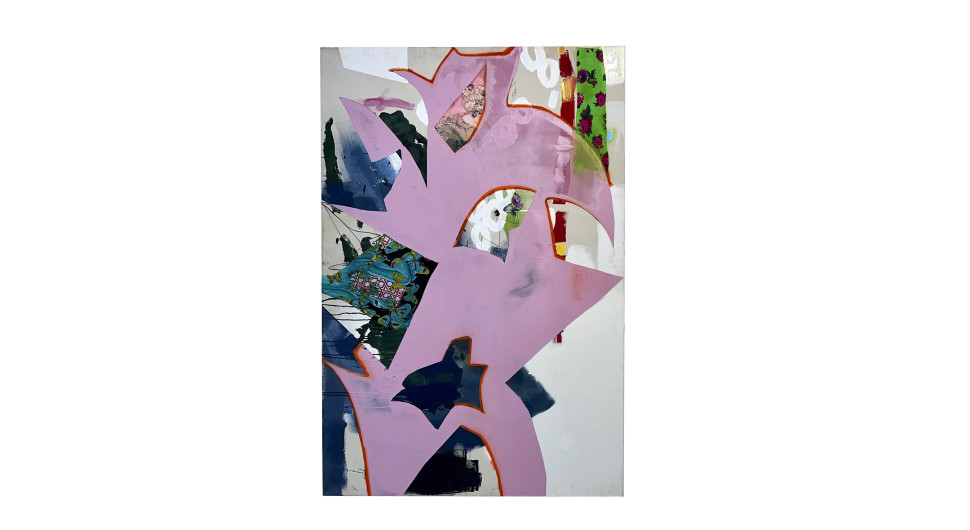
The work that Tala Worrell's produced during the Sheikha Salama Bint Hamdan Emerging Artist Fellowship sprang from a consciousness of visibility– of constantly feeling observed and watched in her body. Perceiving a form of ephemeral documentation of her own body, Tala contrives a fictional, anthropomorphized non-human character; Chameleon, as a figurative took to step outside her experience. A tool to help her observe along with those around her.
Her more recent work continues this approach of material directness and figurative indirectness by collaging pieces of the material environment present in her memory– from Abu Dhabi, UAE, from Beirut, Lebanon, and from Providence, RI, USA.
Worrell’s body of work departs from the "cinematic" idea and seeks to take apart the elements of stories to create newer narratives. She often considers casting characters, storyboarding, and organizing her paintings Shot by Shot through her work.
In the body of work to which "Chameleon Takes a Passport Photo" belongs, Worrell is concerned with non-humans we anthropomorphize to see humanity with greater clarity. She questions why we use cats when discussing specific ideas and dogs in others? In a story, what is the value of using non-humans -animals, reptiles, or plants- as agents? Why are animals a historically valuable tool in political satire and critique?
In Laban Up, the ratio of the work refers to a mirror, and the painting becomes almost reflective of a fragmented personal image. The jagged shapes and collaged elements hint at a sensory experience of trauma. Through the combination of paint and collaged fabrics, Worrell evokes the tension and haze between the past and present.