Botany, Colour, and State Power
By Rahel Aima
|
I Among all the scenes of devastation and pain flashing across my feed lately—the bombs and the beatings, the pleas for oxygen and the bodies washing ashore on the banks of the Ganga, the asymmetric cruelty and brutality of life under apartheid—two videos remain indelibly etched in my mind. In the first, a farmer in Beit Hanoun, on the northeast edge of the Gaza Strip, relaxes on some red and white cushions outside his house. The video is too pixelated to make out their pattern, probably some kind of floral but at this resolution, it resembles more closely the rubbery wrinkles of intestines or a human brain. An artillery from a tank crashes into the picture, and miraculously doesn’t explode but instead spins crazily, its nose drawing circles on the floor like a geometry compass.
In the second video, an old man weeps for the olive trees that he raised like his children, now razed by settlers. I can’t find the video again, but I find so many others that tell the same story. Later, I come across a tweet with two images, forced into a diptych in that way Twitter does, of an olive field aflame. It looks like the golden hour, or maybe that’s just the way the light falls upon that land. The images are incendiary and beautiful until you think about what they represent. Hasn’t history taught us that making the desert bloom is a bad idea?
The more I read the news, the more I feel like one of Mohamed Khalid’s ceramic palm trees, slumped over in defeat. Denuded of their branches, the trunks have the grey and orange palette of a grey hairstreak butterfly, called so because it sports two thin, hairlike tails on its hindwings. Coupled with bright orange eyespots, they fool predators into thinking its hindwings are its vulnerable head and thorax. Around when I visit Total Landscaping, I realise that my hair has suddenly begun greying almost overnight. I fantasise about hennaing it a lurid Uncle Orange, but even though it’s an expression of Muslim piety, today the colour feels inextricable from the chilling rise of Hindutva dubbed the ‘saffron tide’.
II The works in Total Landscaping consider the imbrication of botany, colour and state power in one of three ways. Florals are conscripted to act as diplomatic vessels and tropical vegetation to act as a synecdoche for Southeast Asia. A third tendency documents the landscaping and ornamentation strategies found in the UAE, giving equal weight to organic and inorganic forms. Notably, the triangulation of territories here, the subcontinent, Southeast Asia and the Arabian Peninsula, suggests a cultural mycelial network that is explicitly Gulfy, not Khaleeji.
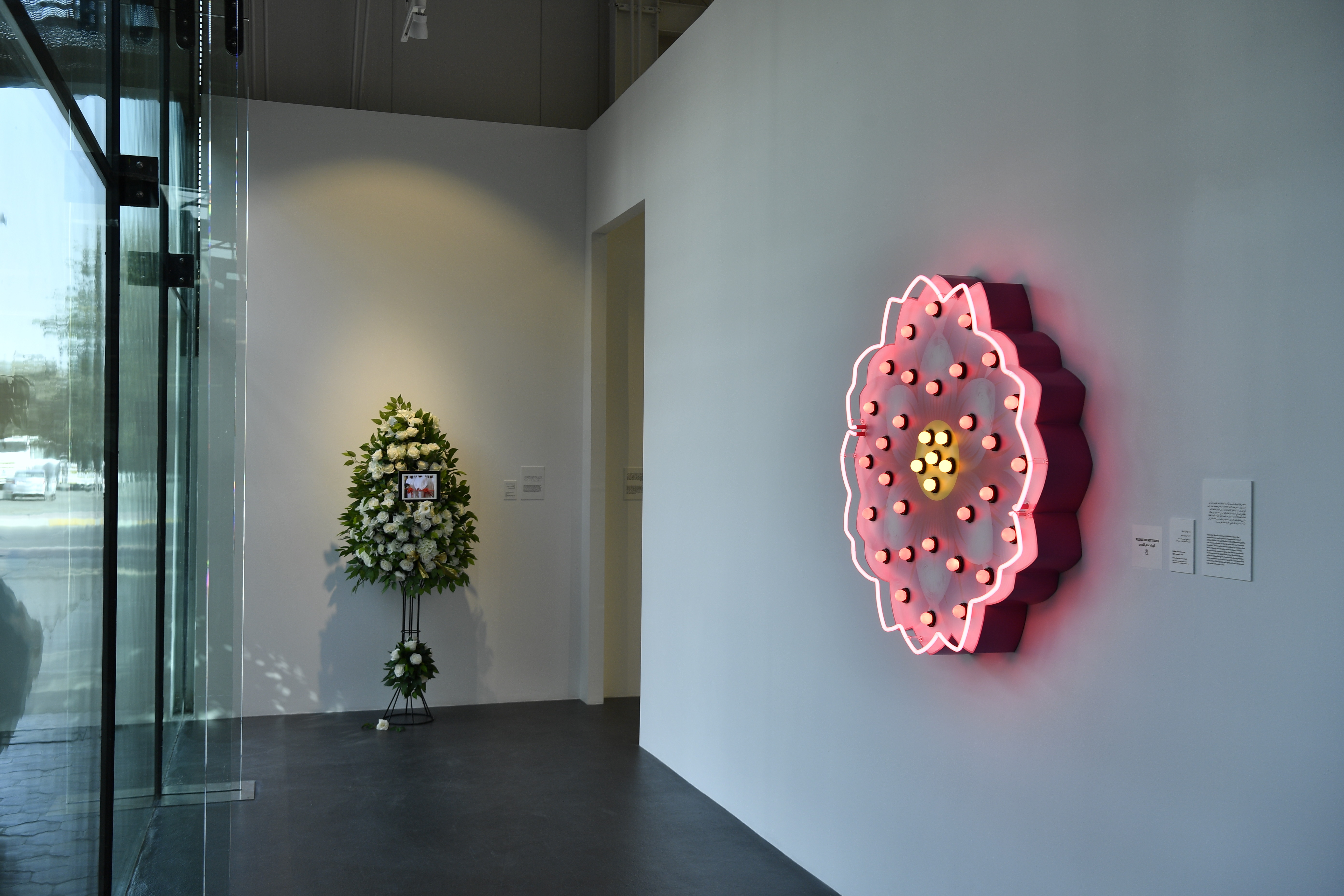
In Iftikar Dadi and Elizabeth Dadi’s Padma (2019), a large lotus is articulated in ombre pink neon, with seed pods intimated by red and yellow bulbs. Like an oud trail, its soft glow invokes the sillage of national identity via India’s official national flower. Other works in the series, not on view here, include an Irish clover, North Korean magnolia, Bangladeshi water lily, Sudanese hibiscus, Afghan tulip and—imagine how it would read if this last work was on view instead— the poppy for Palestine. Nearby is the oversized white floral wreath of GCC’s Ceremonial Achievements in Flowers (2013), secured with a filmy golden bow. In the centre, an iPad plays videos of ribbon-cutting ceremonies. I find myself thinking about Taryn Simon’s photographs of world-historical ceremonial arrangements and Kapwani Kiwanga’s recreated bouquets from the era of African independence, left to wilt over the course of a show. I wonder whether this bouquet will be allowed to rot into an indolic fetor or whether the blooms will be regularly refreshed before the visitor realises that the flowers are artificial.
Gilded frames extend the diplomatic performance in Yee-I-Lann YB-1-10 (2010). This series of vanitas-like photographs zooms in on the hothouse boutonnieres worn by Malaysian dignitaries. Here, the tropical is invoked not just in the choice of blooms but in their evident wilting, mirrored in the flaccid droops of Khalid’s palm trunks. In nearby Singapore, however, politicians seem to keep their cool. Ho Rui An’s Screen Green (2015-6), a recorded lecture performance, considers the political deployment of the green screen—chromakey as well as the city’s greenery—as a backdrop. There, as here, one quickly collapses into the other: the total landscape as a kind of state-sponsored gesamtkunstwerk. Stephanie Syjuco’s Body Double (2007) video sees the Philippines serving as a green screen for a different kind of political theatre, namely Hollywood Vietnam war films.
Wither the Gulf? Photographs from Layan Attari’s Mild Life series (2016) bring the UAE into view. What appears at first as green-scaped scenery—an ivy-covered wall, a tree silhouetted against a cloudy sky, palm trees blowing in a formidable wind—is revealed to be something closer to Ho’s printed rainforest. I think of the way the New Aesthetic described itself as ruptures of digital into the physical except that here it is something more akin to eruptions of the screen in the green. Meanwhile, Farah Al Qasimi’s sumptuous photographs capture the way that florals are used to ornament, with a trifecta of roses fashioned from thinly sliced tomatoes, cake frosting and multifaceted glass. And Hind Mezaina’s lovely, blurry cyanotypes of local flora are accompanied by fragments from Todd Reisz that provide a historical underpinning to the greening of the UAE (at least, according to the British). A colonel LARPs as an East African water dowser, Sheikh Rashid ignores the British political agency’s recommendation of a British agriculturalist who “made Doha blossom” and appoints a Pakistani man, Mr Saari, as Dubai’s official gardener instead. A woman dumps out water on the same empty patch of sand until one day, a tomato plant begins to grow.
III On 25 April, 2032, the moon turned red. At 20:32, it began to take on the reddish tinge of a tourist’s peeling, sunburned neck. By 21:31, it was redder than a pile of Kashmiri Mirch powder. All of this was to be expected. It was the first total lunar eclipse since 2029, and residents flocked to beaches and rooftop decks to see the show. Many drove to inland housing developments in hopes of stargazing, untainted by light pollution. But 22:52, the red began to fade, and it took all the green with it. It was as if chlorophyll had switched allegiances. Frangipani leaves turned the colour of egg curry. Date palms lost their fronds entirely. Groundcover took on hues of mulberry and dark magenta, like swiss chard or amaranth. The ghaf trees looked like they were weeping blood.
Nobody had ever asked the desert if it wanted to be greened. Now, as if freed from its verdant prison, it began to flourish under the blue anti-crime streetlights that now lit all but the oldest neighbourhoods. Outside of their chilly glow, everything quickly died, but then again, there was little that wasn’t cast in blue. Nature exceeded itself, overflowing its neat beds and planters and road meridians. Water bills plummeted: this new red ecology seemed to live on moonlight alone. Landscape technicians tried to reverse the process, bathing the plants with various other colours. It worked, after a fashion, but only inside and with the curtains drawn to protect the seedlings from the slightest suggestion of moonlight.
Tourists flocked to the region to see this strange new algaeic ecosystem, which made it look as if the city was already underwater even though that was several decades away. Residents surrounded themselves with fake plants, and humidifiers flew off the shelves. Nobody knew quite what the red leaves were giving off at night, and nobody wanted to find out; only plastic felt safe. Of course, there was plenty of inorganic green to be found: the dusty mesh canopies of shade netting; all the gardens that were replaced with AstroTurf after the Municipality banned real grass everywhere except golf courses—who introduced tiered green fees—sports stadia and the Meydan turf track in the late 2020s.
Scientists couldn’t understand why the blood moon only affected living plants and not the printed hedges, creepers and other bizarrely temperate foliage that covered every construction hoarding unlucky enough to not display an ad, smooshed even into the crinkled surface of corrugated steel fences—or so they thought. Just under the gummed-down surfaces of these hoardings, hyphae began to bloom and branch like so many furred, filamentous tongues that soon started to wag. After the first rains, little green tendrils began to poke through. There was grass where the ads showed manicured lawns, date palms and olive sprouts on well-tended boulevards, and so on. There was neither soil nor seeds; it was as if the power of the image was finally strong enough.
Images: 1. (Right) Iftikhar Dadi and Elizabeth Dadi, Padma (from the series Efflorescence), 2019. (Left) GCC, Ceremonial Achievements in Flowers, 2013. 2. (Right) Yee I-Lann, YB 1-10 (from the series The Orang Besar), 2010. (Left) Ho Rui An, Screen Green, 2015-16. 3. Layan Attari, Mild Life series, 2016.
|