FIRE WALK WITH HER

Say mashallah; for here she is: back in the game, no stranger to the night. It's been 614 nights since she held your gaze and here she is running through Mina Zayed; burning all those nights...arriving at you...offering no apology.

Fire Walk With Her is a forcefield of film that dares to call David Lynch only by her name; dancing to the rhythm of Mariem Hassan, Aziza Galal and Cheikha Rimitti's souls possessing her veins.

Engaged in a state of play with Warehouse421's fall exhibition As We Gaze Upon Her, this homecoming series; returns triumphantly to Warehouse421; with films by women who carry their stories around their necks, crowning their heads, woven through their voice, baring tales that twist and turn around their limbs scorching the eyes of their onlookers enchanting those who choose to stay.

Dressed as a Cerberus; a sleuthing trifecta of rage, silence adorned with that vacuous sadness of animated smiles; the program will open in October. Featuring the UAE premiere of the Saudi rising star Sara Mesfer's short narrative The Girls Who Burned The Night (Saudi Arabia), Nicholas Fattouh's animated loving letter to his teta How My Grandmother Became a Chair (Lebanon) and Maryam Touzani's Adam (Morocco) her piecing ode to female friendship. In November, despair takes to fantasy with the imagined refuge of Maysaa Almumin's Bent Werdan (Kuwait) and her cockroach friendship and the dark nights of Hala's soul in Hisham Saqr's Certified Mail (Egypt). In December, she will shake it off and destiny's plans along with it. The program closes in December; but only on her terms.In Suzannah Mirghani's Al Sit (Sudan) the girl will say no; while another will demand only a yes as Mayye Zayed's observing gaze honors her pursuit of triumph. The films in this program will leave you mortified, curious and if all goes well; they will humbly devour you. She will leave you breathless, hopeful with your gaze permanently locked upon her. So come, Fire....walk with her! For Water will laugh, Air will crumble and Earth will just dance with her too.


Cinema Akil is an independent cinema platform that brings quality films from across the world to the audiences in the UAE. Showcasing directors and filmmakers across the decades, Cinema Akil aims to create awareness and interest in film and the cinematic arts. Launched in 2014 as a nomadic cinema, Cinema Akil has held over 60 pop-up cinemas attracting over 65,000 attendees in Dubai, Abu Dhabi and Sharjah. In September 2018, Cinema Akil opened its first permanent location in Al Quoz, Dubai making it the GCC’s first arthouse cinema. Cinema Akil’s flagship home is brought to you in partnership with Alserkal. Cinema Akil is a member of the Network of Arab Alternative Screens (NAAS) which includes members from the MENA region such as Metropolis in Beirut, Zawya in Cairo and Cinematheque du Tangier in Morocco. Follow us into the dark.


Location: Warehouse421, Mina Zayed, Abu Dhabi.

 

cinema-akil-60f0116964daa.png (original)  


ESSAY

New Arabic Films About “Her”… And Other Pronouns

Guest writer Ma Hoogla-Kalfat writes about the five films in the curatorial context of the summer film program "Fire Walk With Her".

This article may contain spoilers, a filibuster of sorts in the form of unnecessary wide-eyed mathematical digressions, and some other meanderings, the ultimate purpose of which is to arrive at the truth and nothing but the truth.


Read More

Permutations: an introduction

Let’s step back and begin looking at these films by looking at the film program that brings them together, “Fire Walk With Her”. Skip the title, because to parse it (apparently, a no-brainer) means to parse the part of the original title that inspires it, Fire Walk With Me, a task which, along with parsing the, well, Lynchian film itself, and thus also, inseparably, the original TV series, has kept a cult following busy for (soon to be) 3 decades. Don’t jump into studying or inspecting the films themselves. Again, skip the titles, ignore the credits, the durations, the genres and all the info. By “looking at” I simply meant something as basic as counting; just see how many films these are. Simple as that. But not that simple. Watching the 7 films in this program in the specific order of the event schedule (the opening film, The Girls Who Burned the Night, then Adam, How My Grandmother Became A Chair, J’ai le cafard, Certified Mail, Al-Sit, and Lift Like A Girl), is, you guessed it, only one way, one possible arrangement, among many. But exactly how many? Before you get too excited and start finger-counting the possibilities, or more judiciously reach for a calculator, consider (manually) some of the other ways you could have chosen to watch them:


Lift Like A Girl-Certified Mail-Adam-The Girls Who Burned the Night-Al-Sit-J’ai le cafard-How My Grandmother Became A Chair

Lift Like A Girl-Certified Mail-Adam-The Girls Who Burned the Night-Al-Sit-How My Grandmother Became A Chair-J’ai le cafard

Lift Like A Girl-Certified Mail-Adam-The Girls Who Burned the Night-J’ai le cafard-Al-Sit-How My Grandmother Became A Chair

Lift Like A Girl-Certified Mail-Adam-The Girls Who Burned the Night-How My Grandmother Became A Chair-Al-Sit-J’ai le cafard

Lift Like A Girl-Certified Mail-Adam-The Girls Who Burned the Night-J’ai le cafard-How My Grandmother Became A Chair-Al-Sit… 


These 5 scenarios are among 720 scenarios (yes, you read that correctly) where Lift Like A Girl is the opening film, the same number of scenarios there are for schedules that open with The Girls Who Burned the Night, or that open with any of the other 5 titles for that matter. Multiply 720 by 7 and you’re all set. Or alternatively, in a more straightforward manner, multiply 7 * 6 * 5 * 4 * 3 * 2 * 1. Or, more conveniently, just compute (google) “7!”. Yes, these are the 5040 ways of watching these 7 films, such a small number of films. Beware though—we’re not considering scenarios where one or more of these films are skipped or missed (a bummer film programmers can only live with; it can’t be helped—ideally, every single member of the audience will committedly go and watch every single film in the program), or watched twice in a row, etc. As for the other ways of watching these 7 films, where people’s different experiences, moods, tastes, interpretations and other reception elements, should be factored in, these are, you guessed it again, incalculable.


Here’s the thing then: the curator(s) of this program opted for this specific order ruling out a whopping 5039 options. Why? Is there a logic to it? Does it mean anything? The curatorial statement gives us a clear yes:


[T]he program will open in October… [with] the UAE premiere of the Saudi rising star Sara Mesfer's short narrative The Girls Who Burned The Night (Saudi Arabia), Nicholas Fattouh's animated loving letter to his teta How My Grandmother Became a Chair (Lebanon) and Maryam Touzani's Adam (Morocco) her piercing ode to female friendship. In November, despair takes to fantasy with the imagined refuge of Maysaa Almumin's Bent Werdan (Kuwait) and her cockroach friendship and the dark nights of Hala's soul in Hisham Saqr's Certified Mail (Egypt). In December, she will shake it off and destiny's plans along with it. The program closes in December; but only on her terms. In Suzannah Mirghani's Al Sit (Sudan) the girl will say no; while another will demand only a yes as Mayye Zayed's observing gaze honors her pursuit of triumph.


By merely showing the films in this exact order (over a certain span of time), the curators are telling a story. It doesn’t seem to be a random choice. (I hear you, skeptics, but at least they ended up with a proposed schedule and then saw meaning in it, or gave it that meaning. Can we at least give them that?) Thus, we might wonder: does/can every single order of these thousands of sequences tell a different story? We’re on to something here. Having already watched one of these films on Netflix, then the rest from screeners, I wondered if my own reception was necessarily partly influenced by my own viewing chronology. This was followed by a question that I’m now going to ask you: From most to least realistic, how do you order the 7 films of “Fire Walk With Her”? The following is my own answer. There is no right answer. Actually, many of those 5040 options can be possible answers. The reason has to do with the very concepts of reality and realism.

Realities, realisms 


“There is nothing more real,” Confucius tells us “than what cannot be seen, and there is nothing more certain than what cannot be heard.” Numbers cannot be seen or heard. Numbers Don't Lie, screams the title of a recent book by a famous scientist. Yet we continue to find them crazy. Had this been a 3-film program, there would be only 6 possible ways to arrange them. A mere four more films take things to counterintuitive, exponential results that most of us, those with minds untrained in this kind of magic, would not see coming. King Shirham of India gave his kingdom (and much more), unwittingly, either because he was unrealistic or because he was too realistic, i.e. lacked the numerical imagination. In a Gradgrindian world, reality is nothing more than the aggregate sum of “facts alone” and “nothing but facts”, and Gradgrind himself ceases to make sense, is not as soulless as we think he is judging from our own world(s), but just meaningless.


Much ink has been spilled on what realism is or what it does and what might or might not come across as realistic in the arts (to sound as realistic as possible myself, I should add, “much airtime and many megabytes have been wasted”). But in Alif’s 1995 issue dedicated to “Arab Cinematics”, Tewfik Saleh (a pioneer of realism in Arab cinema, as many sources will introduce him) says bluntly: “I dislike the word ‘realism’... I just don’t find it palatable.” Remarkably, Saleh’s contribution to the thematic issue is mainly about "reception" of Arab films by Arab audiences. To each their reality, Saleh might well have said; to each their realism. Fast forward to 2020: In an episode soberly titled “Signified and signifier” from the economics podcast Invisible Hand, it bugs economist Mohamed Soltan that there is no Arabic word for “realities” in plural form. In fact, there is. But he still has a point. We Arabic speakers never use the plural form, and thus the word - the whole idea - disappears. It’s as good as nonexistent. In English, while “reality” in singular form would evoke psychological and philosophical lines of thought, in its plural form, “realities” has an unmistakably socioeconomic ring to it. However, it seems that “multiple realities”, as some sociologists and modern philosophers tried to establish the concept, is what Soltan is missing; a multiplicity of “finite provinces of meaning” as one of them put it. So far, to speak of multiple realities will generally suggest someone needs therapy or is contemplating science-fictional what-ifs. The more we talk about realities in that sense instead of (a) reality, the more the realities accounted for by economic indicators and motion pictures, the more accurate, honest and just the “inventory” that “started in 1839” (Susan Sontag, “In Plato’s Cave”), the more real it gets.


The 7 films discussed below ostensibly come from 6 Arab countries enumerated in the curatorial statement, but purporting to be set only in 5, including this writer’s country of origin and residence, and thus to show their specific national realities. Four of them are shorts, a film genre or format more compatible with experimenting than longer formats due to production reasons; one of them is a highly imaginative animation; another is a documentary, a genre or a filmmaking mode normally associated with stronger claims to, and expectations of, truth and representing reality, than the narrative (aka fictional) films.

Patriarchy without patriarchs

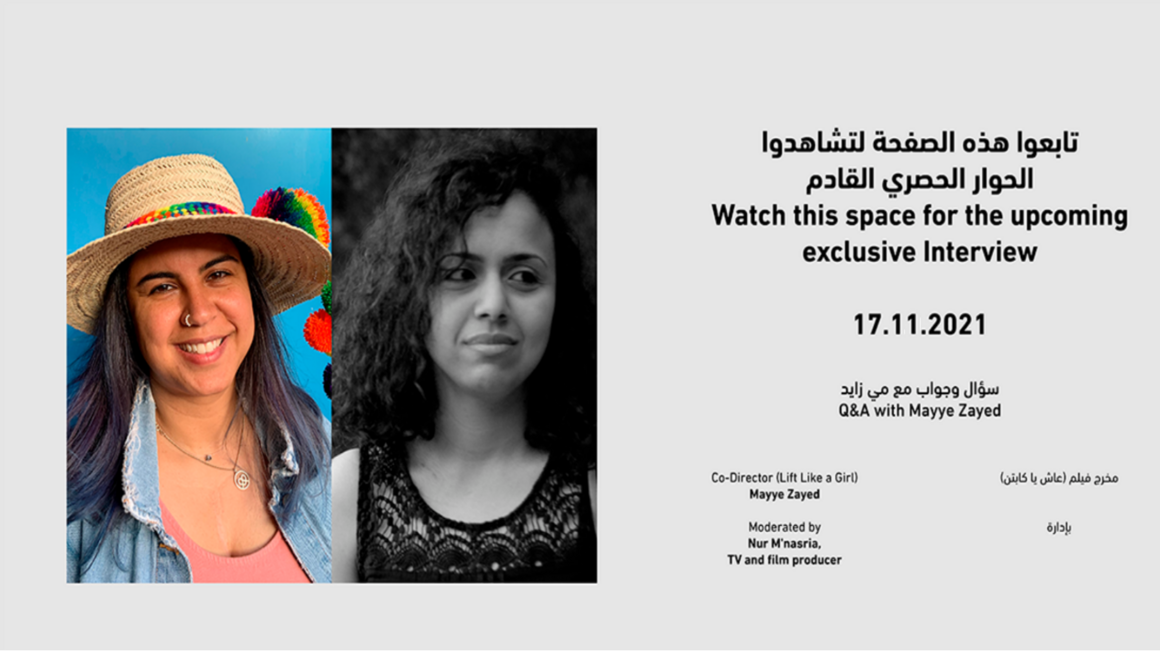
The documentary, Lift Like A Girl (2021), is true to a twofold historical fact: from the outset, Egypt’s top medal-winning sport at the Olympics has been weightlifting, followed by wrestling; in addition to boxing, these together are the historical stronghold of its lower classes, working class or urban proletariat (depending on how one groups the people whose reality(ies) any of these words somehow describes). It should be striking that such a story of domination (albeit a reverse class domination) that figures in a few narrative features - most prominently in two “boxing films”, to use Cate Blanchett’s classification, from 1984 and 1990, both starring Ahmed Zaki - had to wait so long to figure in a documentary feature. Miraculously released at what has been described as a shameful moment for Egyptian weightlifting, Mayye Zayed’s rare film about a not-so-obscure reality picks up the history from the moment Egyptian women triumphantly entered the scene in 2003, having since then changed this reality in its gender dimension. While other sports realities are amplified on Netflix (now featuring HBO’s 2019 Diego Maradona by Asif Kapadia, of Amy fame), Asmaa Ramadan’s coming-of-age-in-real-time story as told by Zayed heroically gives a foothold for a larger story that’s still marginalized on so many levels. Lift Like A Girl is equally the unvarnished portrait of coach and retired athlete Ramadan Abdel-Moati (aka ​​Ramadan Mohamed El-Sayed), and if one or two strokes of brilliance in the Arabic title get lost in translation so that the feminist overtones can survive (but in turn losing all their original subtleness in the process), fortunately we still have the film itself where “Captain” of the Arabic title can be either captain Asmaa or Captain Ramadan. The nice gender neutrality of the Arabic title is not a mere embellishment but eloquently distills a major theme in the film (to say nothing of its other virtues, namely the hint to life, death and immortality). 


Captain Ramadan is one of my most favorite characters in all the documentaries I’ve ever seen, and not just because he’s quite a character—which he is. You almost forget his disability (and his smoking habit and his denture) as he moves constantly doing all kinds of things these able-bodied girls need, which when it comes to keeping bullies away includes throwing stones and spewing out swear words, but not the tirades and finely crafted obscenities that he saves for the girls whenever one of them screws up, or seamlessly fuses within his improvised motivational speeches, or the stories he spins when he’s in a good mood and everyone is kind of chilled. He's every bit the father figure you’d expect him to be as he’s a mother. Class-wise he never tries to fit in the pool of middle-class conservatism that provides the presentable TV-worthy guys, the referees, the men in suit and tie in their reviewing-stand-like seating, or the tracksuit-donning man who takes him away by the arm, grinning, after coach Ramadan got too close shouting his signature outdated baladi cheerleading from a toothless mouth (the English subtitling’s insistence on following him closely is admirable). Social history-wise, he strikes us as a living anachronism, coming all the way from a bygone Egypt with an obsolete culture and unapologetic shaabi attitudes. But what’s even more astonishing is his gender values, beliefs and behaviours, shared and acted out by the teenage girls and young women around him, especially when you remember this (or this brave film) is taking place in an increasingly family-friendly media environment or more generally in a country whose ideological apparatus is increasingly geared towards so-called “Egyptian family values”, acts and expressions against which are quickly criminalized and penalized. These young ladies from the “hood” (some of them wearing hijab on-and-off) sit on the coach’s lap to take selfies, they all take group hugs, and you never sense the kind of physical uneasiness so common in the contemporary world seeping in. Under Ramadan’s gender equality men can make great belly dancers while women can make great weightlifters without any trouble. But this spirit doesn’t survive unadulterated when the girls are eventually addressed as boys, having been expected from start to finish even by one another to “man up.”


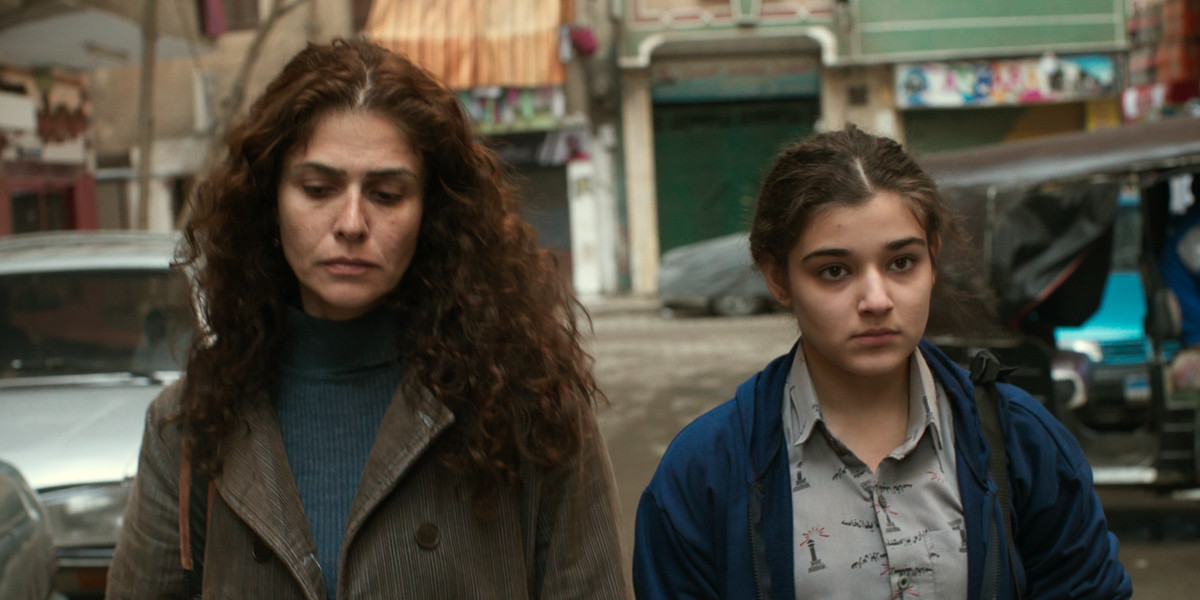
Cut to Hala. She isn’t a “good mother”, is she? In Certified Mail (2019) it is the woman living upstairs who sows our first seeds of doubt, and later implores her rather bluntly to be a better wife and stand by her husband. Yet, at least on the surface, they are good friends and neighbors who care for each other and there’s a sort of unwritten mutual aid agreement between them, which Hala at one point is accused of having breached. Is she that bad and self-centered? Or does she fully deserve our sympathies as the woman whose face speaks volumes about anxiety and great exhaustion, the mentally struggling daughter in grief for her father, the emotionally drained older sister, the mother with postnatal depression feeling disconnected from her own baby girl, and the wife who’s been inviting her husband to sex, or accepting his invitations, only on rare occasions? Could it be both? Does she need to recognize the suffering of the other women (and men) and try to do something about it, shaking off her sorrows or at least burying them in theirs? Certified Mail is an early sign in Egyptian cinema of what might eventually prove to be a shift in how Arabic culture deals with motherhood. Iman Mersal’s forceful book of personal essays How to Mend: Motherhood and Its Ghosts can serve as the opening chapter in such a cultural shift.


The messiness of gender struggle is taken to unsettling levels in Adam (2019). If the Egyptian social drama is mainly about a growing amount of mostly mute friction between women, while men are kind, understanding, dutiful and harmless or even meek, the Moroccan one brings women’s oppression to the fore in a manner that incessantly begs the question of who’s oppressing whom. Women at the bakehouse are slutshaming a preganant Samia after the male baker offers her a chair. We never see or know about the man who presumably “knocked her up” and don’t even know what happened. Viewers will be reminded of Sofia (2018, Meryem Benm'Barek-Aloïsi), another film set in Morocco which also problematizes women’s narratives and the gender conflict revolving around an illegitimate pregnancy, adding to it the class dimension. 


The timid presence of men reaches near-absence in the most realistic of the shorts in this program, The Girls Who Burned the Night (2020), aptly so, one might think, since this is Saudi Arabia. The Arabian desert outside is forbidden to the two cloistered girls in a way that could partly explain why this region has historically produced so few well-known poetesses compared to an impressive number of machoes whose poetry is full of nocturnal adventures. Blanks, silences and minimalism allow for so much complex tension to be expressed in this charged one-day single-location domestic drama that intensifies the sisterly she-loves-me-she-loves-me-not situation playing out in the aforementioned films. Sara Mesfer’s “female gaze” and aesthetics of space and distance go hand in hand with an ethics and a politics: we’re not allowed to go anywhere close enough to even glimpse the scars and burns the singer’s passion cost her at the hands of her brother, a painful reminder that singing or even listening to love songs is a right Arab women have fought for and still fight for and die for as in the music and femicide story of Mohamed Malas’s 2005 Bab al-Maqam (Passion).


The almost never straightforward nature of women’s struggle is something all the films in this program don’t take for granted. This focused curation naturally leads us to think that this program is about patriarchy as an impersonal force, an experiment in looking deeper in a manner that is not possible when we’re distracted by vulgar masculinism and typical all-too-familiar sexist men in male-centered universes, a method akin to “isolating a variable” in scientific method. The next short film makes this curatorial approach even clearer. 


“Matriarchy,” writes Shulamith Firestone in The Dialectic of Sex, “is a stage on the way to patriarchy, to man’s fullest realization of himself; he goes from worshipping Nature through women to conquering it.” Al-Sit (2020, Arabic for The Woman, The Lady, The Mistress) is this worshipped female Nature. She’s identified with the Land, the Soil, the raw cotton that in turn symbolizes her formerly colonized country. And yet, the “misery of the goddess [that] has been portrayed admirably in Satyajit Ray’s 1960 film Devi” as Firestone notes, is also her, and her granddaughter’s, misery, in Suzannah Mirghani’s Sudanese equivalent of the Indian modern-day mythology. Although the historical matriarchy discussed and critiqued by Firestone is not the non-matrilineal form depicted in Al-Sit and practiced by the title’s head of the household - because the film’s allegorical structure, dreamlike mood and theatrical performance still keep its essential realism intact - what’s at stake is the same: “Though it’s true that woman’s lot worsened considerably under patriarchy, she never had it good; for despite all the nostalgia it is not hard to prove that matriarchy was never an answer to women’s fundamental oppression.”

Chimeras

In the two least realistic films, fabulism and mythology are the two laws that inform the fiction’s contractual terms. But even the familiar settings and elements that give J’ai le cafard (2020) its mundane everyday framework within which the unreal wreaks havoc, Maysaa Almumin (read the interview) carefully and ​​almost unnoticeably distorts with what can be described as intentional errors, those kinds of things that would normally be called “goofs” had they been unintentional. One result is that she conflates what can be understood to be Cairo with other unnamed Arab cities. Suddenly this very familiar atmosphere turns out to be happening in a fictitious place, as if in a lucid dream, which lends the nightmarish content an added force and horror. But even more seriously, it becomes what Marc Augé calls the supermodern “non-place”, which is as Mark Fisher explains: “airports, retail parks, and chain stores which resemble one another more than they resemble the particular spaces in which they are located, and whose ominous proliferation is the most visible sign of the implacable spread of capitalist globalization.” ("What Is Hauntology?")


But what is this giant cockroach that doesn’t quite behave like one? The Woman’s visual hallucinations or her “black dog”? Repressed desires? Her alibi for existence? This time, in the absence of a metamorphosed salesman we have no clue as to what or who else is involved in the transformation or chimerical formation. What would have changed if The Woman was The Man?


Although the title’s transformation in How My Grandmother Became A Chair (2020) obviously involves said person and object, neither objectification nor reification is the mot juste. It’s easily decipherable as a metaphor for old age. The more intriguing transformation in this dark and quirky family drama involves an inexplicable two-way metamorphosis ending with a transfiguration of the dying grandmother’s cat/cat-woman/caretaker (back) into a human being, while her own offspring turn into werewolves or she-wolves (“she or he”?).


Almumin’s and ​​Nicolas Fattouh’s films are two of the latest additions to a growing list of visual, audiovisual and literary works from the Arab world that over the last decade have featured such chimerical or metamorphic themes, of which Maha Maamoun’s Dear Animal (2016) and Omar El Zohairy’s Feathers (2021) are only two examples. To try and understand this phenomenon we’ll need to look at an increasing interest in animals at least in the Egyptian media and an unprecedented increase in pet adoption that writer and psychologist Shady Lewis says is open to interpretation as telling of a misanthropic trend or an extension of a new humanistic politics to include animal rights.

“Batwannes beek”

To call an animal, a cat or even a cockroach - or anything or anyone who keeps you company - family, is one of the different meanings of fire in this film program. It’s not only feminine anger. It’s also the warmth of company around a firelight and the security and guidance of torches for a caravan of travellers through the dark. Fire that must be redefined and rediscovered though. Family that must be reinvented. It can be found in correspondence or even anonymous letters.  


There is a moving scene in Jacques Demy’s 1961 debut feature Lola, in which Madame Desnoyers shows Roland Cassard out and says: “We’ll be lonely without you.” She and her teenage daughter have barely made the young man’s acquaintance. This scene is wordlessly echoed in the closing scene in Adam. Just why does she have to go?

Ma Hoogla-Kalfat (formerly known as MF Kalfat) is a cultural worker/producer based in Cairo, Egypt. He has translated between Arabic and English, edited Terr.so, a film e-zine, hosted and programmed film screenings and contributed to publications.

Through a grant from AFAC, Hoogla-Kalfat is currently writing a book, Covering the Naked, that tries to map the occurrences and appearances of the naked human body/nudity across a labyrinth of literatures, discourses, visual images, popular cultures and daily life experiences in Egypt and beyond.

ESSAY

To Have The Cockroach, To Kill A Cockroach: Interview with Maysaa Almumin

Guest writer Ma Hoogla-Kalfat interviews  director Maysaa Almumin about ther film Bint Werdan which is shown as part of the summer film program "Fire Walk With Her".

This article may contain spoilers, a filibuster of sorts in the form of unnecessary wide-eyed mathematical digressions, and some other meanderings, the ultimate purpose of which is to arrive at the truth and nothing but the truth.


Read More

To Have The Cockroach, To Kill A Cockroach: Interview with Maysaa Almumin

[This is an edited version of an email exchange with the artist-architect-filmmaker.]


Ma Hoogla-Kalfat: J'ai le cafard (Bint Wardan, 2020) is your second film, following, the internet tells me, Musing in the Desert in the same year, and followed by a more recent one, ...And I Was Left Behind (2021). All shorts. You’ve actively engaged in filmmaking after years in architecture, where the latter meant an artistic practice and an academic career, but also a business. How did this development come about? 


Maysaa Almumin: To clarify, Musing in the Desert was made as two separate films in 2018 and then re-edited into one film in 2020. 


I am definitely gearing my filmmaking to position it within my design practice and Musing in the Desert was an exploration of that. As a partner in the design collective Architects Independent with Thomas Modeen, we had always talked about wishing there were films for design as there were films for music or food or clothes. The film format is a readily accessible and consumed medium, an efficient and convenient method to exhibit work that transcends the sometimes elaborate practicalities of physical exhibitions. Much of our design work creates small acts of personal ritual or ceremony, so to spin stories and narratives around what these could be was a way to create the scripts for the film. Our two daughters were kind enough to participate, one in front of the camera and one behind the scenes, so that particular film has the whole family involved!


As you noted, I started making films quite late in my career compared to many filmmakers. I've always had an unconsummated interest in film. As a student I was encouraged to watch certain films while I studied architecture at the Architectural Association School of Architecture, but I felt sometimes that watching became my way of procrastination, renting piles of “foreign language” films from Blockbusters instead of preparing work for my portfolio. Coming from a family of engineers, by studying architecture I had deviated enough, and I had never thought of filmmaking as an option.


Moving to Qatar was definitely instrumental in reviving my interest in film, with the annual film festival and the Doha Film Institute being an active entity in the creative field. That and hitting my mid-forties made me eager to learn and start making films.


In the lead-up to that phase in my journey, I started acting in short films. I took it as an opportunity to learn filmmaking on set and observe the process. I observed the kinds of roles written for an Arab woman of my age but also for women in general. I once lamented that the roles written for a woman of my ethnicity and age were barely significant, and a friend challenged me to write a film with the role I'd like to see or play. That's the approach I take in my films. Well, I appear in two of them!


As I reflect on the roles I have written for my characters, I recall a conversation I had with a friend director when I'd mentioned that as I took up the task of writing roles for women, I wondered if I could challenge myself to write good roles for men, to which he replied, “Why decide the gender of the role in the first place? Why not decide that during the casting call and see which actor fits it?” Actually I'd say that in my films the same characters can be played by people of any gender, and that is  perhaps a subversive statement on gender in and of itself. I still want to write scripts with women as their central characters but one day I would like to explore that approach during the casting.


Warehouse421’s summer film program actually tackled what some of the participants call ‘design film’ and I wrote a piece as part of that pointing to a recent critical effort to establish a more comprehensive genre, ‘process films’. With these aspects of interdisciplinarity and transmedia in mind, can we also look at filmmaking as an academic tool? It’s worth noting that you and Suzannah Mirghani, whose film al-Sit is also featured in the current program, worked together. You both share this aspect in your practices, by having this dual identity or playing this double role, so to speak, as both filmmakers and academics.


Indeed, I see Bint Wardan as a piece of research. Film is a versatile tool that could be further explored. You mentioned 'design films' and 'process films' and there is room for other genres to be developed in this area. 


Your question brings to mind The Powers of Ten by Charles and Ray Eames. I first saw it in an exhibition in London when I was seven years old and at the time I didn't speak English and had no idea what the narrator was saying but I was mesmerized. The next time I saw it was years later in my first year studying architecture. A tutor got mad at me for using the words 'small' and 'large' and told me to watch this film before I used those words.


I also think of Beka and Lemoine. Their films are essentially architectural studies through the perspective of people who know best a particular domestic setting; for example in Koolhaas Houselife, where we are introduced to an intimate perspective of the building through the interactions of the housekeeper.


I have worked with a few design students to use film to question design issues by proposing, and speculating through, narrative films, which resulted in some evocative outcomes. Some of those films spin small stories around the use of objects, or create scenarios that explore social settings and the effects of technologies in temporal contexts. The way that film allows one to project futures makes it an ideal format for investigation and speculation.


You wear many creative and intellectual hats, while your 3 or 4 shorts come with this distinct multiplicity of modes, forms, purposes or genres. Your work also challenges the normal labelings along national lines production-wise, since you are active between Europe and the Arab world, a Kuwaiti based in Qatar with one of your films (the one we’re showing and discussing this time) being classified as Qatari-Kuwaiti, almost misleadingly at least for many Arab viewers who’ll be surprised to watch what looks like an Egyptian film. How do you explain the choice of shooting this film in Egypt (or more accurately - since we don’t really know - with Egyptian actors in what looks like a workplace in Cairo)? One can easily think that your film was shot in another Arab capital, which also makes one think how far neoliberal globalization has gone when it comes to corporate culture, workplace design, etc.


You raise a good point. I asked myself these very questions before shooting this film. Production county in filmmaking is technically defined as the country that the production money comes from, regardless of the filming locations or the content of the film. I would also like to point out that when festivals allow me to include as many as three production countries, I always mention Egypt as the third production country in recognition of the place where I shot the film and many friends and crew members showed generosity, for example by contributing one of the locations (a private flat) and covering some extra expenses from their own fees .


During the pre-production I considered shooting in Qatar and playing the main role myself. But there were many good reasons for shooting in Cairo. Until Covid-19 hit I had spent a lot of time in Cairo for the sake of various creative workshops and collaborations. Over three years I used to visit the city three or four times a year at least. I wrote the script in my free evenings while I was there. I attended a workshop with Ayman El Amir to develop the script there. Earlier, while working on a number of film sets in Qatar, whether for my own films or for other filmmakers, some of my crew members were Egyptians who later moved back to Cairo. Primarily, the cinematographer I had worked with on my previous film projects was Mostafa Sheshtawy. I love his work and I knew I wanted to work with him again and he had moved back to Cairo by then. There is also Eiman Mirghani who co-produced the film with me and lives in Qatar but is Sudanese-Egyptian. It was easier to take the filming to my crew than to bring my crew to the filming.


I eventually realized I no longer wanted to act in the film, and decided to be completely focussed on directing while on set. This made me ask myself: How then does this become a Kuwaiti film? 


Here's where neoliberal globalization that you referred to comes in. How can we know for a fact in which Arab city the film is set? I spent very few years working in Kuwait, and in two of the three offices I worked in I was the only Kuwaiti. So in fact this film is far closer to representing an office in Kuwait city than the film I had initially had in mind.


The film itself winks to this question of context of location and nationality through clues I left in the image. The names of the contracted companies mentioned by The Boss and the names of restaurants mentioned by The Colleague are all names of actual places in Kuwait. 


Another wink to that in my film is my appearing in the background as an office worker. Also, a fun fact: My husband speaks Swedish, and the name of this fictitious company in the film is Fjaril & Co. “Fjäril” means butterfly in Swedish. It’s a pretty insect vis-à-vis the loathsome cockroach. The office was made by the amazing production designer Ahmed Saad Eldeen, who conjured up that office including the detailed branding of all the things in it from thin air, creating the bright and chirpy environment as an antithesis for the muted home of The Woman.


Essentially I have created a collage of two cities, the one I am perceived to be from and the city I love and have spent so much time in. Incidentally, the idea of collaging two cities is also another reference to another film I was involved in, Muneera, a Kuwaiti film by Oscar Boyson, produced by Kuwaiti-Puerto Rican artist Alia Farid as part of her curation of the Kuwaiti Pavilion in the Venice Biennale in 2014, where the main character meanders between Kuwait City and Venice, re-enacting a 1929 short story with the same title. We do this for the purpose of shifting architectural contexts and, in so doing, it becomes a means to observe and compare the narrative contexts of two different cities. I used that approach in Musing in the Desert too, changing physical locations of objects which in turn changes meanings and perceptions.


Wow, this short film is a study in slipping subtexts and hidden messages! Another lens that Bint Wardan adds to the multiple lenses you’re bringing to your filmmaking has to do with the title’s (less silent) co-leading character, partly an inanimate object, and partly a real living creature, a cockroach (many cockroaches actually). As it happens, “Bint Wardan” is one of many nicknames in Arabic (whether dialectical or standard or classical) for animals, birds and insects, that humanize them in an almost anthropomorphic manner. We’d normally say “sarsour” (as in the film’s Arabic closing titles), or more colloquially “sorsar” (in Egypt). On the one hand, the film has by necessity a touch of entomology (à la Buñuel), with an unmistakable hint of Kafka (without any need to force the ubiquitous and often gratuitous use of the adjective, “Kafkaesque”). One hundred years from Kafka’s Die Verwandlung, the working woman in your film awakes to find herself not transformed to a gigantic insect, but literally in bed with it (and here, I can see Freud joining in). While Kafka is associated with allegories, the absurd, and modernity and its discontents, Bint Wardan can be situated within a postmodern context and a posthuman turn.


Absolutely! I would also like to add Charles Baudelaire (“J'ai le Cafard” is his expression) and Bruno Schultz.


This film is kind of semi-autobiographical. Many years ago I was working in a large corporate environment, feeling hollow and unfulfilled, when I encountered a dying cockroach in the office toilet, on its back wiggling its legs in the air. I felt sorry for it and for myself at once, as I waited for nature to take its course and put it out of its misery instead of taking action myself by helping it up or killing it. 


Years later as I contemplated writing this script, I reflected on that moment and felt it was in effect a sense of solidarity with this cockroach given our equally miserable situations, that we were together in this. This helped me to divulge my inner feelings, my mental state.


I am extremely aware of the associations with Kafka, so I decided to take the referencing to the max. In the opening credits, on the nightstand there is an unfinished read, The Streets of Crocodiles by Bruno Schultz, a writer repeatedly compared to Kafka. The book contains a story with the theme of human-to-animal transformation, where The Father escapes from the overbearing women in the story by becoming an insect and disappearing into the cracks of the wall.


The French expression “avoir le cafard” literally translates to “I have the cockroach” and means being depressed or having the blues, which is the general premise of the film. Writing provoked me into digging the expression more, and thus I learned that the word “cafard” may have Arabic origins in the word kafir which means “infidel” but also, more accurately in this context, a person in a state of disbelief. This knowledge fed back into more reflecting on The Woman's motivation to find solace in this bizarre friendship, her disenchantment with her surroundings, the way she feels, and how she’s communicating with her depression as it materializes in the form of a giant cockroach.


I made that giant cockroach with my bare hands by the way! I shipped the cockroach in pieces and then it was assembled by the talented Mohammed Fakharany, an outstanding sculptor and special effects artist I had met when I participated in a silicone molding workshop in Cairo. 


Another author your film brought to my mind is Tawfiq al-Hakim, whose play Masir Sursar (The Fate of a Cockroach) moves beyond the fabular and the absurd to an existentialist approach to the human condition with an emphasis on power and gender struggles in a domestic setting. But back to “J'ai le cafard”, the expression ascribed to Baudelaire, I find it intriguing because this is also the writer who famously established “ennui” and “spleen” as literary sensibilities, turning them from mere 19th century variants of boredom and melancholy into powerful creative forces. But if his and his fellow upper-class intellectuals’ response to this condition was through flanerie, your woman is a 21st-Century depressed working woman in the Third World. This intertextuality pits labor against leisure, male against female, East against West, a modern era against another. Or am I overanalyzing?


By using metaphoric and fantastic elements in my film I do invite and expect people to interpret the film, and that's inevitably going to be subjective. I definitely have my own take but it is far more intriguing to see how others would look at it as you have demonstrated. The way that you have (over)analyzed it does ring true to the underlying issues I address but the film doesn't make a definitive statement. 


The corporate setting does play a part, but for me it pits success against fulfilment, expectation against desire.


You’re right. I intentionally present the main character as a single woman, and make no mention of a romantic past or dependents or any relationships. She seems relatively successful and valued. I wanted to pare down the situation to one woman's dealing with her own depression and the moments that drive her to have agency over her situation. Everything else is a blank space that needs to be filled in.


The current film program, “Fire Walk With Her”, places your film (where the title’s pun in “Bint”, Arabic for daughter, must be intended) in the context of recent Arabic films whose topic is “woman”, Arab woman for that matter. The two films in your diptych, Musing in the Desert, deal with mother-daughter relationship and woman vs authority (or power) in its different meanings. Is this a feminist project in film form? And how would your desire to write gender-flexible roles fit in this endeavour? I’d also like you to shed some light on your experience of directing actresses/actors while being an actress yourself (in Falling Leaves you play a dead mother being mummified by her son and daughter!)


As I said, I wanted to write films with roles for women that aren't supplementary roles, through the female gaze, so to speak, and naturally, that's bound to be an exercise in feminist storytelling. Through different narratives, my films bring out small glimpses of gender conflict and struggle and feminine frustration. 


The idea of writing gender-flexible roles is something that excites me, although I am aware that realistically, since gender conformity isn't going away at the moment, I would have to let go of narrative control and allow the film to create its own narrative direction. It might be an interesting experiment to shoot a few different takes with different genders for the same roles each time. When I picture that as applied to the films I’ve already made, I can imagine very different outcomes but also possibly similar ones, depending on the actors’ performance.


Many years ago, I had the good fortune to be mentored in acting by Scandar Copti and, very briefly, by Daniele Suissa. I learned from them a lot about how I wanted to be directed and about performing for the camera in general. I sometimes joked that I joined acting workshops due to a creative midlife crisis! I had intended to learn about filmmaking but at the time there weren't any well structured programs near me about making short films. I rationalized that learning to act was like reverse engineering to learning to direct. True enough, as an actor one gets more opportunities to take part in projects while the opportunity to be on set as a director is significantly smaller. As an actor, I observed several films being made and the inner workings of a filmset. This is also how I learned to direct actors more effectively.


About acting in Falling Leaves, that was one of my favourite roles to play! I used to act for first-time filmmakers and film students as a way to actively support and be part of the emerging film industry here in Qatar. Dimitri Yuri, the director and actor in the film, is an alumnus of the university where I work and I love his scripts. As my focus shifted to filmmaking, I turned down roles much more than before. Also, the older I get, the scarcer the roles to play a middle-aged Arab woman if any. So with a script like Dimitri’s Falling Leaves, I knew I really wanted to be part of it. I wouldn't play that particular role with any other director. A friend of mine once joked that the roles I'd previously played were either crying or dying so this script suited me down to the ground.

Ma Hoogla-Kalfat (formerly known as MF Kalfat) is a cultural worker/producer based in Cairo, Egypt. He has translated between Arabic and English, edited Terr.so, a film e-zine, hosted and programmed film screenings and contributed to publications.

Through a grant from AFAC, Hoogla-Kalfat is currently writing a book, Covering the Naked, that tries to map the occurrences and appearances of the naked human body/nudity across a labyrinth of literatures, discourses, visual images, popular cultures and daily life experiences in Egypt and beyond.