
Born in Damascus and raised in the U.A.E, Sawsan is an artist, architect and researcher based in Dubai. Sawsan seeks the discreet ways history has influenced culture in the region, narrating her notion of home as myth within works of graphite on paper, digital scans, and text. An intense draftsmanship is the basis of her work, and she employs digital-scanning to access and depict an absent homeland. Her meticulously drawn poetic entanglements fall at the crossroads of past and future, evoking an intimate past image, and her text and the titles of her works highlight to the viewer the tension between the real and the fabricated.
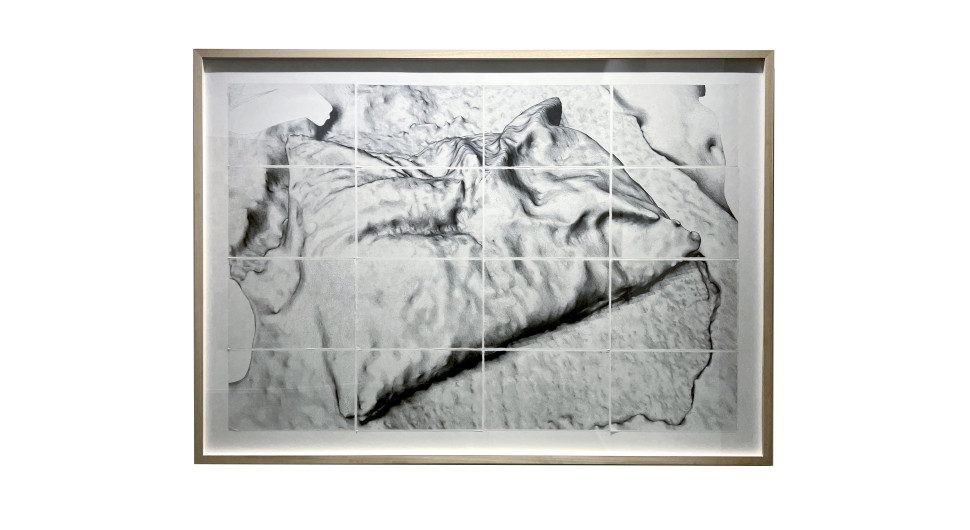
Sawsan Al Bahar's work studies contexts, time, and narratives that attempt to uncover intrinsic histories and investigate an absent home's physical and intangible characteristics.
Through fragmentation, and with dots and lines, she pulls together the smallest units that make up images invoking what she describes as the disorienting permanence of transitory states of suspension and waiting.
In her work In the forest of estrangement. 2017, Al Bahar purses the obscure influences of history on culture in the region by narrating her notion of home as a myth through intense draftsmanship, digital scanning, and using these tools, she is then able to access the absent homeland. In this work, meticulously drawn poetic entanglements evoke an intimate past image that situates itself comfortably between the real and the fabricated.
In Untitled study for home.2020, Al Bahar attempts again through detailed drawing to evoke a sense of a past reimagined, reconstructed, and not forgotten, using her late Grandfather's memoir as both a departing point and a juncture of arrival.
Here is an excerpt of her Grandfather's memoir:
From the memoirs of my grandfather, Zuheir:
Wednesday March 19, 2 p.m:
“Although I am, naturally, aware of the good things that awaited me in dear Damascus, I find myself reluctant to leave Jaffa, where my eyes have opened and seen the world for the first time, where I had the good fortune of being surrounded by love and appreciation on all sides; where I had the privilege of a first class primary schooling; where I was chosen to recite a very simple poem before an audience of parents who came to attend a celebration of I don’t remember what…
...Now, after nearly seventy years, I find it difficult to leave Jaffa, just yet. What about my naughty driving the car of my mother’s doctor by just pushing the starter button till it went into a kind of swamp, driving the doctor to almost madness and making him determine not again to visit my mother, calling after me in his French pronunciation of the word عفریت:
عفغیت!! عفغیت!!
...What can I do with tens of episodes like that. They press for recognition and I find it difficult to
ignore them.”
Sunday March 23, 4 pm:
“And how about my friends at the club? How can I leave them just like that without touching on
several occurrences that are stuck in my memory, craving expression! My reluctance to leave Jaffa, just as yet, may be appreciated, I think, by a sympathetic audience. I hope I am right. If not, I close this “session” with a certain degree of trepidation and I resign myself to the Merciful Creator, and pray.”
Before he passed away, my grandfather wrote his memoirs, dedicating entire chapters to Jaffa. With his mother and siblings, he left Palestine in 1947 as a child for a family visit to Damascus, unbeknownst to him that he would never return again. 70 years later, Jaffa would not leave him.
I contrast these fragments of his remembrances and the blaring trumpets of his reveries with my wispy drawings, searching an imaginary substance for Jaffa, and the everlasting dream of home.