
Viewers and Not Dwellers
By Saad Choeb
So different, so appealing is the fourth in a series of exhibitions entitled Substructures, conceived by Murtaza Vali and curated for Warehouse 421. The exhibition takes the real estate industry as an entry point to investigates the domination of neoliberal aesthetics and narratives. It consists of a trio of short videos, monoprint series, advertisements, graphite drawings, photographs, another video and an installation. The title of the exhibition is taken from a 1956 collage by English artist Richard Hamilton, “Just what is it that makes today's homes so different, so appealing?”, which Hamilton cropped from a real estate magazine advertisement. Although real estate agencies try to sell differences, in fact they reaffirm homogeneity; global urbanism becomes the model followed for economic development. Architecture appears for viewers and not dwellers, while people’s participation becomes irrelevant. This piece aims to explore time and disruption under neoliberal order as contemplated through Vikram Divecha’s “Demolition Monoprints” and the BROKER video of Jennifer and Kevin McCoy.
Fast Forward:
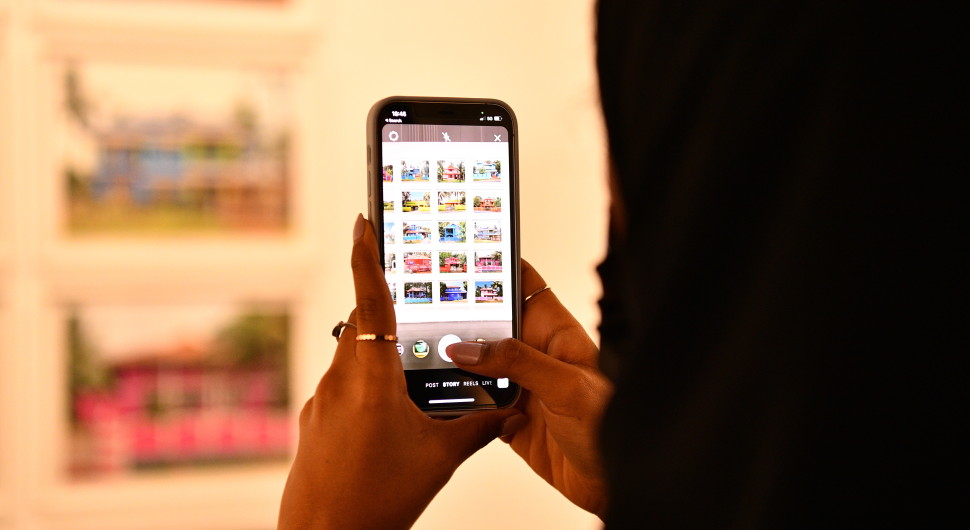
The Messenger app now permits users to speed up voice notes, allowing you to play them up to two times faster than the speed at which they were recorded. Originally, the tone of voice may be regulated to suggest emotions such as anger, surprise, fear, happiness or sadness. Emotional prosody or affective prosody are the multiple non-verbal characteristics of language that enable people to convey or understand emotion. This includes your tone of voice in speech, which is perceived through changes in pitch, loudness, timbre, speech rate and pauses. When I first arrived in Dubai a month ago, I became stressed out by the double-speed distorted voices that I was hearing out of the devices in my surroundings. My brother-in-law had told me that he uses the feature for movies, “so he can accomplish more in less time”, a basic equation for profit.

Demolition:
The urban development in the Gulf is similar to speeding up voice notes “to accomplish more in less time”. Time shall not be accumulated—or we better not be aware of its passing—otherwise we will feel confused and even faint. Here, the temporal consciousness brings unnecessary dizziness as it becomes a subject of contemplation and not a material reality that can indicate time in relation to lived experiences. The material reality is simply demolished. What is left is tomorrow, neither yesterday nor today. Vikram Divecha addressed the question of forced future through creating “Demolition Monoprints”, a series of prints made at an impending demolition site using an inked wall or surface. While the prints document the moment of erasure, they also commemorate the space and the lives of people who lived there by reproducing some of the interior details of these spaces, such as the kitchen tiling, a torn down wall and an arch of a corridor. Although such attempts towards the past might immediately be deemed as merely nostalgic, I think Divecha’s work drifts away from a sentimentality for the past. The pieces are not associated with a yearning for the past and its possibilities or personalities; rather, they act in the present. The past is conjured not as a call to remember it as an event but instead as an antithesis of the futuristic domination over the temporal order under neoliberal economies. It is like wondering what would happen if we tried to put a stick in a spinning wheel.

BROKER, 2016 Jennifer and Kevin McCoy Video (28 min) Courtesy of the artists and Postmasters Gallery
Slow Down:
In his book The Politics of Aesthetics, Jacques Ranciere suggests that domination functions in a way that forces us to feel that there is one unique reality, surrounding our experience with a framework that makes our world appear obvious and inescapable. Meanwhile, dissensus disrupts this obviousness. It resituates the visibility of our world, and ceases, accelerates or slows down its temporal course, creating new modes of seeing things and new methods of making sense of them.
In their BROKER video, Jennifer and Kevin McCoy depict visual art as a disruption of the normal. The video portrays a broker who is preparing an extravagant apartment in New York’s Trump World Tower to show to potential clients. While making sure that all the furniture and details are staged perfectly, she repeatedly recites the custom-designed features in the apartment and describes its luxurious finishings. In the middle of her well-ordered roaming in the apartment, the broker becomes unsettled by the unexpected eruption of disruptive works of art in the apartment, such as paintings of some violent and other distorted figures. Although trying to suppress the images, her speech starts to sound hysterical as she repeats her neoliberal anthem before descending into madness.
Now, the erasure of the limits between common sensible realities — i.e., the reality of the content of the disruptive artworks and the reality of the broker’s routine — has opened up a political space. Her madness seems analogous to a form of emancipation whereby stopping doing her typical business freed her from all the mechanisms of ordinary perception. The rupture that the artwork created has reframed the visibility of the world for the broker. Hence, the efficacy of the artwork resided in the redistribution of time and space that it produced, leaving a margin for drawing commonalities that can no longer be overlooked. The temporal order, on the other hand, flows like an original voice note where emotional prosody is recognised.