
Ammar Al Attar: The Width of a Circle
By Mohammad El-Jachi
Ammar jumps, Ammar circumambulates, Ammar plots the width of a circle. He inches his way through an irrigation duct. He stamps endlessly against blank paper, then a wall. He dots and dashes with the careful gestures of a bureaucrat.
“These are performances. This is performance art. You like performance art, don’t you?” I remind myself, after an hour spent shuttling in and out of Ammar Al Attar: Out of Range.
Now I’m scanning book spines at the giftshop. Rock, Paper, Scissors, Positions in Play, in three variant color schemes. Have the red one, haven't read it. Same with 1980–Today: Exhibitions in the United Arab Emirates.
Did they end up using my product descriptions I wonder? There's Hala Al Ani's Liminal Vase, and Dima Srouji's Hollow Forms. Seems about right. It's hard to tell though, nearly two years later, where the spreadsheet text ends and I begin.
Now I'm back here, watching Al Attar endure his endurance performance in Moving 1 (2021), which happens to be the only work he isn’t wearing a kandura in. He’s only just started pulling his way through the fallaj now, so I’m in for a good three and a half minutes. This is as painful as it gets, for the both of us.
Al Attar’s first solo exhibition and outcome of Warehouse421’s Artistic Development Exhibition Program sees the Emirati photographer and mixed media artist plowing the fields of covid-era, work-from-home ennui with a series of outdoor performances.
Being asked to write about, or at least write aside, this exhibition for Warehouse421 has me in more or less the same position as every commission has had me. I’m not exactly sure how to begin the piece, other than that I’ve arrived at the space, or been at the space for some time, and that I’m, for whatever reason, antsy or underwhelmed or taken aback or usually just a bit confused.
So what am I trying to get at exactly? What do we talk about when we talk about performance art? It is, I think, worth mentioning, not what I necessarily think performance art is in any clear categorical terms, as much as what it has meant to me, in the past two or so years, and what I thought a study or even a practice of "it" could do for me.
I used to work at a local art magazine, between 2019 and sometime around May 2020? Saying you used to work at an art magazine, especially when you held the position in question for no more than six months, is always a cool thing to do. Especially if you were an Editorial Assistant, but: “more of a Junior Journalist actually, towards the end of it…”
My first three attempts at writing about any sort of performance art or artist — two pseudo-reviews from an arts festival in 2020, and a certain obituary caption from around the same time — I don't consider to be interesting or notable enough to elaborate on.
It had to have been a few months later, scouring the Barjeel Art Foundation's artist database for works to include in a very timely Covid-inspired Instagram art series, that I first came across a very young Mohammed Kazem.
You know the one(s), where he has his tongue nearly lined up with a keyhole, stuck to a door knob, inside a dellah, and so on. Now, these fit the bill perfectly. Tongue on door knob, recently-instated COVID-19 restrictions, I'd really caught a break with this one. We ended up tagging all three of his accounts, which he seems to use interchangeably. The post was a hit, all things considered.
I've painstakingly reproduced the very modest caption below:
“In an age of obsessive, mandatory sanitisation and minimal contact, we look at Mohammed Kazem's (@mk201099 ) work Tongue (1994). In stark opposition to current hygiene protocols, we see him about to insert his tongue into a keyhole. This presents a sensory overlap between the acts of tasting and touching as ways to understand and interact with the object. Photographed by his mentor, the late Emirati artist Hassan Sharif, the work is an important early example of conceptual and body art in the UAE. We appreciate the artist's carefree, experimental approach to interacting with his environment, even more so as we've been made to adopt our own sort of hyperawareness of our surroundings.”- [02/04/2020]
God.
Tongue (1984) probably seemed like a cool thing to do at the time. Why, though? Did I identify, on some level, with his similarly hooked nose and sloping forehead? At the time, I might have found his willingness to be photographed in profile as brave as the tonguing itself. Maybe I’ve been reprimanded, by both friends and family, for picking up cool-looking sticks and stones my entire life, and enjoyed his freedom to not only lick all over the place, but to have a very understanding and supportive authority figure document the act for posterity?
In my last month on the job, I came across another classic: Hassan Sharif’s Jumping in the Desert (1983). It was with great enthusiasm that I requested this image, amongst others, from Alexander Gray gallery in New York.
In Jumping in the Desert, Sharif seems to stagger, recover and propel himself forward, into the desert as you’d imagine. In this diptych, along with Jumping No. 1 (1983), Walking No. 2 (1983), and Digging and Standing (1983), I saw how even the most perfunctory acts could be isolated, stylized, rendered gestural.
The pipeline — from private (the performance itself) to public (the potential to experience the act after the fact through the repeated reproduction and distribution of said images) — the delayed voyeurism inherent to these works, was liberating.
Staged in an undisclosed location in Hatta, they immediately brought to mind the many empty sand lots, rife with trash and vegetation and the occasional, poorly concealed cache of empty beer cans and used whippets, that I considered to be the most privately-public / publicly-private spaces I could find in Al Ain. What these works gave me was a sense of expansiveness, one that was very much attainable.
With all this in mind, I began to cultivate what was perhaps a juvenile, and solipsistic appreciation for both my comings and goings (during many a solitary evening walk), and my ““built-environment””.
In the six months I spent back with my family, I was usually on the roof. There was just enough wifi connectivity to get away with Zoom calls, and plenty of room for activities. It was a bit dusty, but I never minded that.
One evening, in the middle of a sudden July downpour, I decided that it would be a good idea to sweep the roof. Sweep? How do I refer to, in English, the cleaning act performed with the squeegee head broom / Floor squeegee? I shatifed until the rain died down.
The next day, I noticed that the displaced sand, dirt and pigeon poop had made what I thought to be wonderful inkblot-esque patterns on the roof. I decided that I'd continue to shatif, as a sort of durational performance and discipline-building exercise and record myself throughout. I would also photograph each splotch as newly displaced dirt dried and collected between cleaning sessions.
Other canned, and equally ridiculous “performance” concepts included:
- Set up a metal ladder on the roof in the morning, right around dawn. Go back up to the roof every hour, on the hour, between sunrise and sunset, and touch the ladder. Record reaction (Which I imagined would range from “Ouch!” to “Umph!” to “…” depending on how hot it had gotten). Knowing myself, however, I doubt I would have been able to summon up much more than a barely visible wince.
- Walk barefoot along some sandy, rocky area near my building at around 12-1 PM. Capture whatever stream of consciousness drivel I expected to produce throughout the duration of the performance on my phone’s recording app. Transcribe and publish as some sort of shoestring zine or free PDF.
The continuity of my project and recordings would soon be ruined, both by getting a hair and beard-cut and another heavy downpour that messed with the slow evolution of my existing dirt-splotches. Sometime in October, I also decided to get out of Al Ain with what little money I had left to help my friends in Dubai move.
Thus commenced the brightest and darkest chapter of my 2020 return to Dubai arc. Since I thought I'd be back in Al Ain within a month or less, I felt a real need to commemorate the three locations I'd spent the most time in while living and working in Dubai pre-lockdown. Or at least, that was the least embarrassing way I would end up rationalizing it to people:
- Al Qouz: Gallery visits, a Bauhaus-themed reading group that I barely kept up with, and my first taste of press clout.
It started out innocently enough. Out with a friend, I was once again tasked with taking her photo. I don't remember if she asked me to pose in kind or if I was trying to flip the script, but I jammed myself in-between two buildings, leaving about half of my body exposed. I was wearing black jeans that mostly fit, busted Namshi Chelsea boots, and a blue thrifted windbreaker. I was feeling good; that was as fashionable as I ever got.
- Jumeirah Village Circle (JVC): Where I couch-surfed and futon-dragged between October 2019 and the very end of March 2020, then for another two weeks in October 2020 before moving to Marina with my friends (they didn’t know it at the time though). Lots of male-bonding and domestic tension.
This one was as simple and guileless as shimmying into some sort of large PVC pipe. I was with the same friend. This was our second time seeing each other since lockdown, and about a week before I’d be helping my friends move out of JVC.
- Corniche street, near the Sharjah Art Foundation: SAF
At this stage the project had taken on a new level of intentionality. I had my two roommates photograph me in an alleyway near the edge of SAF after a screening of Metropolis at the Flying Saucer. This was the final installment of the "Insertion series (2020)", and I was determined to outdo myself. We spent about an hour scouting out different nooks and crannies to insert my hands, head, and feet into.
The idea here, aside from it being a purely commemorative act, was to somehow "interface" with my built environment in a grittier, more contemporary homage to Kazem’s Tongue series. To what real end? I can’t recall. The best shot we got was of me in a sort of awkward lunge, my left hand behind my back and my right stuck up a jagged hole in a drainpipe. This was ground-breaking stuff.
Funnily enough, I remember being very proud of these three photos. I even went so far as to print them out as polaroids right at a Marina Mall kiosk. The second installment in this series went on our fridge. And so, for a very short time, “performance art” was simply something cool that I could do, either alone or around one or two people I was comfortable enough with.
I am glad to say that, aside from a few months spent recording various gestures and movements for a video project led by Mona Ayash, this is as far as I've taken my very, very nascent practice.
Circling back to the actual exhibition…
Ammar’s performances are confined to clearly defined parameters, his movements careful and measured. Take Line 1 (2020) and Line 2 (2020) for example. In the former, he spends 17 uninterrupted minutes drawing single black marker lines on a4 sheets. Al Attar is seated, his range of motion as restricted as the camera’s vantage point.
The latter sees him running a charcoal line across a weathered, nondescript wall. While the line thickens throughout the video’s 8-minute run-time, the plot definitely doesn’t, not that it needs to. He never fails to alternate hands, switching at the end of every pass, the streak widening into more of a gash on my line of vision. Stamping 1 (2020) and Stamping 2 (2021) follow this same shift in scale.
Watching this on my laptop at half past midnight, I can say that the sound of charcoal on concrete goes from performance ASMR to auric cavity scraping at around the 3-minute mark.
Covering 1 (2020) is the artist at his most vigorous. Here Al Attar weaves a tightening web of black cloth for himself, all within a solitary concrete cube. Shaky handheld camera work and the sound of buffeting wind add a much-needed sense of urgency to the work. Around the half-way mark, we’re treated to a beautiful shot of the sun streaming through billowing fabric, before zooming out to reveal the unwieldy tangle that Al Attar continues to exasperate.
As the video comes to a close, we see him ascend a small flight of steps, inspect his handiwork, and exit. Is this him leaving behind a web of cumbersome interpersonal relations? An increasingly convoluted professional landscape? Who is to say? Even in this work, he’s operating in close confines.
Retracing my steps, I arrive at the 20-second Jumping 1 (2021), which loops on a color TV-set near the show’s entrance. Here an 8 mm Al Attar disappears, in Wile E. Coyote fashion, down an empty water basin. According to the exhibition catalog, this is Al Attar’s attempt at testing the limits of his physical and mental endurance (classic mind over matter), to arrive at a moment of self actualization. The same could be said for most works in Out of Range.
A classification of the end-goal, this going beyond oneself, is one that I’ve often thought of in reductive binary terms. What mode or flavor of catharsis is each performance arriving at? A knee-jerk answer: one that is predominantly either physical or mental, born from an act of introversion or extroversion.
One example is On Kawara’s One Million Years, a work that lists each year for the one-million-year period preceding the artwork's conceptions, and the million years that follow it. While not exactly a performance piece in Kawara’s hands, it has been performed many times. The official (and I believe only) 2002 recording takes up 32 CDs.
Accuracy, along with mental and vocal endurance are paramount here. A capacity and appreciation for disciplined repetition, for what it's worth, is then the likely outcome for One Million Years’ performers (and I guess something about the passage and marking of time, though I’m not especially interested in that).
On the other hand, there’s Chinese artist Zhang Huan.Some of his most prominent performances include My New York (2002), which had him traversing the city’s streets during the Whitney Biennial in a herculean body suit of fake meat and To Add a Meter to an Anonymous Mountain (1995), where Huan and nine other performers created a human pyramid to do exactly what the title of the work suggests. These performances, to me, outline new possibilities for the body and its utility. An elaborate build-up and break down of body armoring, so to speak.
It goes without saying that these works cannot be defined as wholly-neck-up or neck-down experiences. This perfunctory classification breaks down even further when we consider the effect of a performance on the artist vs. onlooker, and that these works, experienced in real-time (or at least in their entirety via recording), do not necessarily deliver an immediate sucker-punch of thought and feeling that can be classified as either/or, unlike say the choice performance stills I touched on earlier. Rather, it is more accurate to describe this impact as a slow diffusion that permeates throughout.
And with the above in mind, I think I’d liken the works in Out of Range to low-impact exercises that are better for you than you’d expect, if you can stick it through.
I dare say that my favorite part of Out of Range is a wall of 81 A4 pages, documenting Al Attar’s research process, his inspirations and aspirations. This is the artist at his most endearing as he revels in the potential of each experiment and personal breakthrough. Aside from the very clear influence of Hassan Sharif, he’s also read up on other performance art notables including Lee Wen and Bas Jan Ader, the Dutch conceptual and performance artist who famously set sail from Cape Cod on the 9th of July 1975 and was never seen again.
With the inclusion of Ader in mind, I wonder if Al Attar sees this final performance as a sort of lofty Dionysian ideal or more of a cautionary tale to those who venture far enough out of their jurisdiction. Al Attar seems to be in the process of both struggling against and coming to terms with this notion throughout his current body of work.
Ultimately, the works Al Attar has presented in Out of Range are by no means as transgressive as his forerunners’. This was never the point, though. It would be wrong to expect this of him. There are more than a few artists running around here who fit that bill well enough.
I think that this exhibition accurately reflects the life and times of a man with a healthy understanding and respect for the mundane, whose life may in many ways be dictated by it. He carries that sense of order with him, cultivates it, and hints at possible upheavals in the future.

Mohammed Kazem, Tongue, 1994. 9 silver gelatin prints on mounting board. 41.5 x 41.5 cm (overall), 10 x 11 cm (each print). Collection of Sharjah Art Foundation.
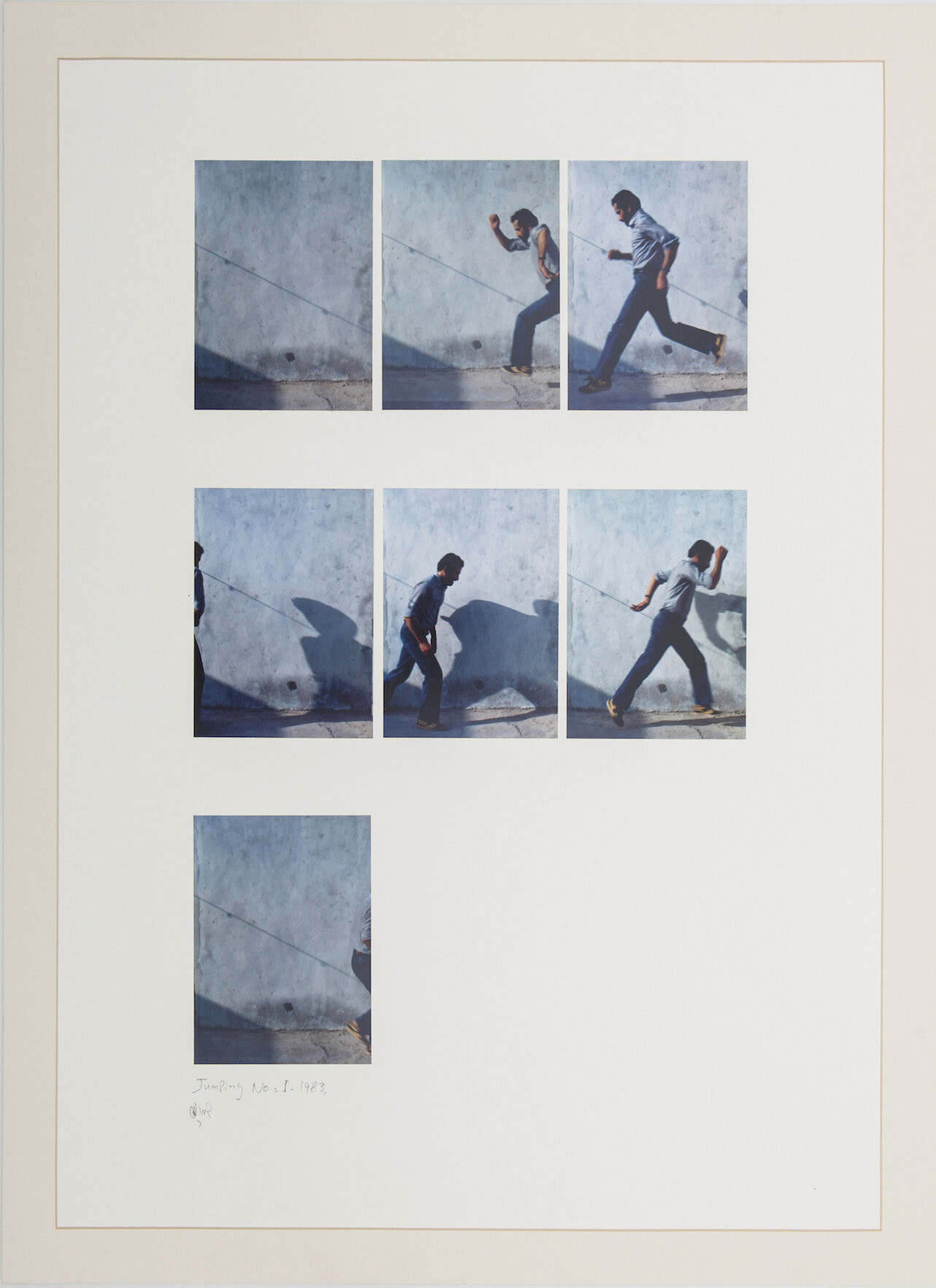
Hassan Sharif, Jumping No. 1, 1983 98 x 73.2 cm Photographs mounted on cardboard. Guggenheim, Abu Dhabi.
1 Lifted from David Bowie’s The Width of a Circle off of his 1971 album The Man Who Sold the World.
2 A publication that accompanied the Venice Biennale’s 2017 National Pavilion UAE exhibition.
3 A publication that brings to light, through a range of archival materials, the practices of several major Emirati artists.
4 Hala Al-Ani is a UAE-based Iraqi artist, designer and professor at AUS’s College of Art, Architecture and Design (CAAD). Her Liminal Vase series employs the salt formation across aluminum mesh frames to create vases, tables and more.
5 Dima Srouji is a Palestinian architect and visual artist whose Hollow Forms glassblowing project combines traditional Palestinian artisan glassblowing with a unique sense of experimentation.
6 I freelanced briefly for Rouya PR, which at the time handled Cinema Akil, Art Jameel and Warehouse 421 amongst other art and culture entities. This very nice gig was cut short by a painful full-time social media copywriting job.
7 An ancient irrigation system that has been integral to the persistence of agriculture in the UAE and the surrounding regions.
8 This is a reference to Danish post-punk group Ice Age’s 2014 album Plowing Into The Field Of Love.
9 I've used this same play on the title of Raymond Carver's celebrated short story collection, What We Talk About When We Talk About Love, in the opening line of a 553 write-up on Tarek Atoui: Cycles in 11.
10 A founding Emirati conceptual artist who is still very much active today. Very funny guy.
11 A contemporary art gallery in New York City and Germantown, NY that represents Hassan Sharif along with Isabelle van den Eynde in Dubai and GB Agency in Paris. They’ve got a pretty good press section on their website, I’ve got to say.
12 The built environment refers to any and all aspects of our man-made environment. It’s also a term that’s been used and abused in many an artist statement, group exhibition open call and curatorial essay.
13 شطف / / شَطَفَ / shatif / shatifed
14 One of Dubai’s young professional-friendly areas, provided you have a car.
15 The act of strategically moving a futon between someone’s bedroom and the living room, depending on how late everyone else is planning to stay up. A step above (and below), couch-surfing.
16 After landing the full-time job (more on this in footnote #6, I ended up staying the entire year).
17 The Sharjah Art Foundation.
18 Released in 1927, Metropolis is considered one of the first ever feature-length science fiction films.
19 SAF’s latest outpost, a flying saucer shaped building from the 70’s that has been converted into a mixed-use center with a cafe, work area and exhibition space.
20 I met Mohammed Kazem for the first time at this year’s Art Dubai. While third wheeling on a conversation with him and a mutual friend, I had half a mind to show him the series in question, but decided against it, thankfully.
21 A Dubai-based Palestinian artist and Zayed University professor whose practice focuses on repetition, memory, slowness and boredom. She recently exhibited her video work Folding Bellies (2020) with support from Warehouse421.
22 A beloved cartoon character who often fights a losing battle against gravity.
23 An enigmatic Japanese conceptual and process artist
24 One of China’s best known conceptual and performance artists.
25 A concept developed by second-generation psychoanalyst Wilhelm Reich, body armoring refers to the supposed mental-muscular defense pattern that is built up by an unconscious desire to shield oneself from pain or trauma.
26 This line is adapted from the song Death Will Bring Change off of Parquet Courts’ 2018 album Wide Awake!
27 One of Asia’s founding performance artists, most known for his iconic The Journey of a Yellow Man series.