
Zainab Imad Eldin
This work investigates internal racism amongst Sudanese people, more commonly termed colorism, through the lens of a black, Muslim, and Sudanese woman. Racism in Sudan transcends skin color, its roots settling well into one’s ancestry, tribe, and religion.
In Sudan a spectrum of words is used to describe each shade of skin color, commonly used in a racial context. The primary ones being ‘ahmar’(red), ‘asfar’ (yellow), ‘asmar/bunni’(brown), ‘akhdar’(green), and ‘azrag’ (blue), and over time, the spectrum expanded to include names of particular shades of a skin color. While they are referred to when describing someone, they are also used in a derogatory manner.
It’s a much more difficult struggle for women, having to deal with social pressure on looking a certain way, as a result, many find themselves using harmful chemicals to satisfy these impossible standards; erasing their color, and subjecting themselves to potential harm.
The color blue is particularly notorious because it’s used to describe South Sudanese. Blue refers to blue-black, the darkest shade before black. I chose the four primary colors on the scale, and took them by face value, to question the existing scale, and highlight the absurdity of discrimination.
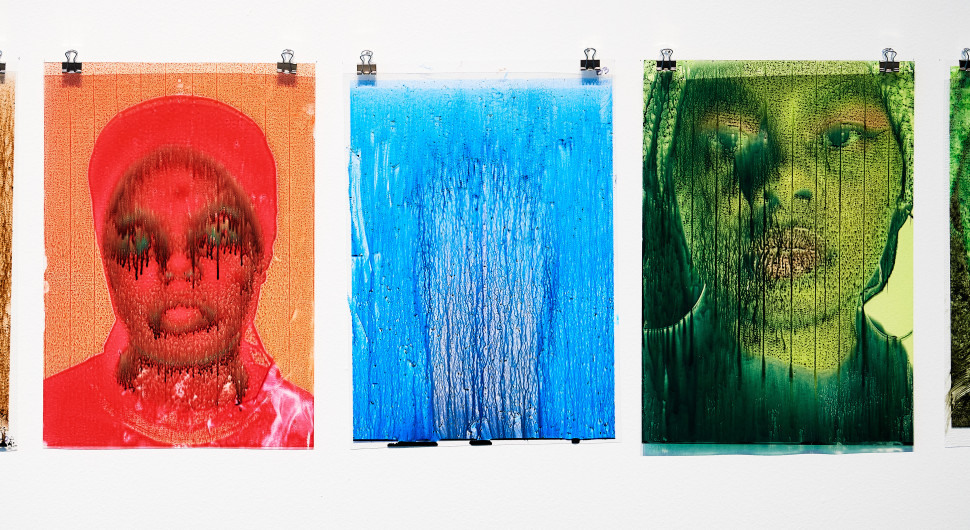
Zainab Imad Eldin’s work comes from a place that’s close to home. She develops a chromatic vocabulary on internal racism in Sudan, turning the lens on herself to depict how color becomes the root of dissolution rather than composition. Her photographs are painterly in their deterioration, melting her features. As Imad Eldin multiplies all the different ways in which her face can be perceived, the colors on a spectrum of yellow, red, brown, green and blue – representing various degrees of darkness – aren’t treated equally in their stages of decay. Each photograph is a documentation of degradation that occurs because the ink doesn’t bind to the acetate prints. It’s also symbolic of the artist’s need for unlearning – even unseeing – the implications of color in her home country.
While contemporary artists ranging from Angelica Daass to Lina Iris Viktor have tackled racism in their societies by creating particular pantones around skin tones, this is a more radical project that employs color as a source of opacity. Interestingly, it came out of a happy accident when Imad Eldin was experimenting with a blue filter projection and her figure disappeared. As the darkest shade before black, blue seemed an interesting lens on forms of erasure and oppression.
Zainab Imad Eldin is a Sudanese artist and designer based in the UAE. She uses art to help make sense of her identity as a Sudanese woman while exploring the struggles encountered in Sudanese society. She uses materials that have significance in Sudanese culture and transforms them to create a specific dialogue surrounding these issues.